
Jonah
Coleman.
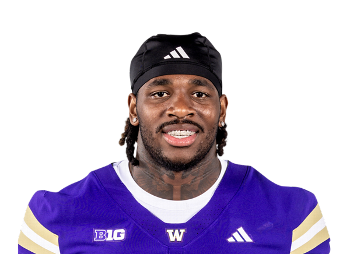
Jonah
Coleman.
 Washington· 5'9"· 229 lb
 R4 · #108 · Denver Broncos
"Compact bell-cow with contact-balance and downhill vision — an every-down grinder whose short frame and average long speed cap the ceiling but not the floor."Pre-draft read
Coleman aligns primarily in single-back gun, with occasional reps as an I-form tailback. He demonstrates patience pressing wide-zone tracks before hitting downhill. His primary win trait is contact balance, absorbing initial hits to gain extra yards, and a secondary trait is his feel for passing downs, quickly plugging interior pressure and catching angle routes and swings out of the backfield. His feet are efficient, with decisive plant-and-go ability.
He plays with his pads under his shoulders, finishing runs through the second level. While his long speed is average, chunk plays originate from broken tackles rather than vertical burst. His pass-protection technique against blitzing nickels requires refinement. He is a natural catcher on angle routes and swings out of the backfield.
Shanahan outside zone run scheme
Rotational back who can convert short-yardage and spell the starter on passing downs Year 1, with a ceiling as an every-down zone-scheme runner who provides both power and receiving upside.
A spread RPO system that relies heavily on outside-track speed and consistent explosive gains, which would minimize his contact balance and receiving value.
Coleman projects as a scheme-versatile back whose one-cut ability and receiving prowess make him a valuable asset in a run-first offense, despite his average long speed.
Jonah Coleman 2026 NFL Draft Highlights
Career highlight package covering Washington production, contact balance and receiving reps.
Top Plays vs Colorado State — 08/30/2025
Season-opener top plays showing the downhill vision and short-area burst that carried the 2025 tape.
Washington Pro Day Workout
On-field position work: agility bag, receiving drills and pass-pro mirror reps in front of NFL scouts.
Coleman projects as a compact, three-down rotational back with legitimate receiving and pass-protection utility. Teams are buying a back who consistently converts short gains into positive yardage and contributes reliably in the passing game, mitigating his average long speed with contact balance and versatility.
He emerged as a significant producer over four seasons, splitting his career between Arizona and Washington. After an 871-yard season with Arizona in 2023, he followed the team to Washington, where he posted a breakout 1,053-yard, 10-touchdown season in 2024. His senior year saw a dip in rushing volume to 156 carries, but reinforced his receiving prowess with 354 yards and 15 rushing touchdowns.
Evaluators noted his 4.55-range forty time and 5'9" frame as factors limiting his ceiling, keeping him out of the mid-rounds. Consensus placed him as a Day 3 selection, valuing his third-down capability but acknowledging that his weight-to-speed ratio was a significant flag. He was ultimately drafted in the fourth round.
- 01
Contact Balance
Coleman absorbs initial hits to gain extra yards, consistently turning short gains into positive yardage.
- 02
Pass-Catching Ability
He is a natural catcher on angle routes and swings out of the backfield, with 87 career catches for 838 yards.
- 03
Efficient Footwork
Coleman demonstrates decisive plant-and-go ability, pressing wide-zone tracks before hitting downhill.
- 04
Pad Level and Finish
He plays with his pads under his shoulders, finishing runs through the second level.
- 05
Pass Protection
He quickly plugs interior pressure, showing utility and contributing reliably in the passing game.
- 01
Average Long Speed
His 4.55-range forty time limits home-run ability, as chunk plays originate from broken tackles, not vertical burst.
- 02
Pass Protection Technique
Technique against blitzing nickels requires refinement, which is a real evaluative concern.
- 03
Ceiling Limitations
His 4.55-range forty time and 5'9" frame are factors limiting his ceiling, keeping him out of mid-rounds.
- 04
Weight-to-Speed Ratio
His weight-to-speed ratio was a significant flag for evaluators and a concern for his draft stock.
| Yr | Team | G | Att | Yds | TD | Rec | RecYds |
|---|---|---|---|---|---|---|---|
| 2022 | Arizona | 12 | 75 | 372 | 4 | 8 | 24 |
| 2023 | Arizona | 13 | 128 | 871 | 5 | 25 | 283 |
| 2024 | Washington | 13 | 193 | 1053 | 10 | 23 | 177 |
| 2025 | Washington | 12 | 156 | 758 | 15 | 31 | 354 |
| Career | — | 50 | 552 | 3054 | 34 | 87 | 838 |
A dash means the figure is not published by a source we trust — never a zero we invented.
- Demond Williams Jr.QB30%
- Denzel BostonWR12%
- Dezmen RoebuckWR7%
#2 of 15 tracked contributors · Production leaned on volume · Offense explosiveness 1.26 (p60) · CFBD — usage x PPA per tracked player
Late-Day-3 rotational bell-cow with legitimate 200-carry seasons in a shared backfield — the honest median outcome.
Compact three-down back who wins on vision and contact balance rather than burst — realistic ceiling if the receiving role holds.
Undersized change-of-pace and third-down specialist who carves out a long career on protection reliability and receiving reps.
Everything above is the pre-draft evaluation. This section is what actually happened — updated year over year.
Pre-draft context
Coleman built his stock the long way: three-star out of Stockton, four-year producer split between Arizona (2022-23) and Washington (2024-25), and one of only a handful of running backs in the class with genuine three-down passing-down utility on the tape. The 2024 Washington season — 193 carries, 1,053 yards, 10 touchdowns — was the calling-card year that pulled him into the Day-3 conversation, and a senior year that dipped in volume but produced 15 rushing scores and 354 receiving yards kept him from sliding out of it. The board consensus was a fourth-to-sixth-round compact back with functional receiving skills, capped by a 4.55-range forty and a 5'9" frame that never let evaluators dream of a lead-back projection.
NFL fit — Broncos
Denver takes him at 108 as a complement to the incumbent backfield, not a replacement. The system has historically valued backs who can align in empty and take the third-down snap, and Coleman's 87 career catches project cleanly into that role. Realistic Year-1 usage is 6-8 touches per game with pass-protection reps on obvious passing downs; realistic Year-2 usage is a 1A/1B split if the pass-catching translates and he holds up as a between-the-tackles closer inside the 10. The fit is clean: a zone-heavy run scheme, a team environment that will scheme him touches on angle routes and screens, and a locker room that rewards the low-maintenance grinder profile he carried at both college stops.
Retrospective
Day-3 backs live or die on what the offense asks them to be. Coleman won't out-athlete anyone, and the ceiling was always the honest median of a Kimani Vidal type rather than a hidden bell-cow. The pick makes sense if you believe in the receiving role and the contact balance carrying to Sundays; it does not make sense if Denver expected long-speed explosive runs. Grade the outcome by three-year touches and pass-protection snaps, not by yards-per-carry.