
Jeremiyah
Love.
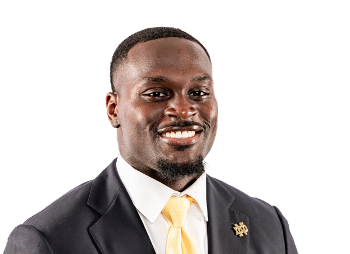
Jeremiyah
Love.
 Notre Dame· 6'0"· 212 lb· 4.36s 40
"A 6'0", 206-pound Notre Dame back who went from 17-TD sophomore to Heisman-finalist workhorse, pairing home-run speed with hurdling contact balance — a top-five talent whose one-cut vision settled the RB1 argument."Pre-draft read
This primary tailback aligns from single-back and pistol formations, operating effectively in both gap and outside-zone schemes. He presses the mesh point with patient tempo before executing a violent one-cut, exhibiting vertical explosion through the crease. He maintains leveraged pads into contact to finish runs falling forward.
He displays functional bounce and body control, incorporating hurdles, spin-outs, and lateral cuts without losing forward lean, which converts creases into chunk gains. He possesses naturally soft hands as a receiver, tracking the ball over either shoulder and adjusting routes dynamically. In pass protection, he is willing and technically sound, recognizing blitz pressure, squaring his frame, and delivering a punch.
The Arizona Cardinals' spread RPO scheme with pistol and shotgun looks would perfectly leverage his three-down capabilities and receiving upside.
He can immediately step in as the primary tailback, with the ceiling to be a feature back who impacts all three phases of offensive play.
A purely power-run heavy scheme that relies on downhill, between-the-tackles grinding on every snap rather than leveraging his one-cut ability.
Love's versatile skill set as a patient runner with explosive one-cut ability, natural hands, and solid pass protection will make him an immediate impact player in an RPO-heavy system.
Jeremiyah Love — 2025 Season Highlights
Full Heisman-finalist campaign reel: hurdles, home-run runs and receiving reps.
Jeremiyah Love — 2024 Highlights
Sophomore-year 1,125-yard, 17-TD tape showcasing the one-cut vision and contact balance.
Jeremiyah Love — 2024 Notre Dame Highlights
Alt cut of the 2024 sophomore campaign with the viral hurdle plays and long touchdown runs.
Love projects as a legitimate three-down back, offering a rare combination of rushing power, receiving versatility, and pass-blocking ability. His functional body control and ability to accelerate through the open field make him a consistent threat for significant gains, embodying the profile of a foundational offensive skill player.
He matured into a workhorse at Notre Dame, showcasing his talent with a 1,125-yard, 17-touchdown sophomore season in 2024, followed by a Heisman finalist campaign in 2025. His usage extended beyond rushing, demonstrating receiving upside and consistent production within an elite offensive line scheme against ACC competition.
Concerns among evaluators centered on the precedent of drafting a non-premium position at a high slot, and his athletic testing profile remained unverified at declaration. Despite these discussions, his tape and consistent production solidified his status as the consensus RB1 and a fringe top-five overall talent, leading the Arizona Cardinals to select him third overall.
- 01
Contact balance and finish
Runs through arm tackles at the second level and consistently falls forward through defensive backs, keeping his pads leveraged into contact with an ability to stack yards after first hit.
- 02
One-cut vision on zone
Presses the mesh point with veteran patience, waits for the linebacker to declare, and plants a single hard foot to hit the crease vertically without stringing extra dance steps.
- 03
Home-run speed
Legit second gear once he clears the second level; the ACC tape has multiple 40-plus-yard house calls where he simply outruns pursuit angles from safeties and corners in the open field.
- 04
Receiving upside
Natural, soft hands on checkdowns, wheels and option routes out of the backfield; tracks the ball over either shoulder and can be schemed detached looks as a matchup piece.
- 05
Elastic body control
Rare functional bounce and lateral flexibility for a 200-plus-pound back; the hurdles are the headline, but the everyday value is subtle spin-outs and jump cuts that arrive without stalling momentum.
- 01
Interior anchor in pass pro
Willingness and technique are there, but he can get walked back by heavier defensive tackles on twist pickups; will need pro strength work to hold up against NFL interior rushers.
- 02
Occasional bounce trigger
Vision on split-zone and duo can drift toward the sideline when the initial crease muddies; must trust his blockers and take the four-yard interior gain instead of hunting a chunk outside.
- 03
Durability question
Missed time with lower-body knocks in both college seasons on a heavy workload; frame is compact but the projection to a full pro workload without a rotational share is unproven.
- 04
Fumble security under contact
Ball carriage has been mostly clean but drifts away from his frame on second efforts and stiff-arm attempts, and there were multiple 2024 punchouts on plays where he tried to extend for extra yardage.
— — — positional median (p50)
- 40 yd
- 4.36sp50
- Vertical
- —in
- Broad jump
- —in
- Three-cone
- —s
- Shuttle
- —s
- Bench
- —rep
| Yr | Team | G | Att | Yds | TD | Rec | RecYds |
|---|---|---|---|---|---|---|---|
| 2023 | Notre Dame | 13 | 71 | 385 | 1 | 8 | 77 |
| 2024 | Notre Dame | 16 | 163 | 1125 | 17 | 28 | 237 |
| 2025 | Notre Dame | 12 | 199 | 1372 | 18 | 27 | 280 |
| Career | — | 41 | 433 | 2882 | 36 | 63 | 594 |
A dash means the figure is not published by a source we trust — never a zero we invented.
- C.J. CarrQB21%
- Jordan FaisonWR8%
- Leo ScheidlerWR7%
#2 of 18 tracked contributors · Production leaned on volume · Offense explosiveness 1.50 (p99) · CFBD — usage x PPA per tracked player
Well-rounded three-down back with plus vision, above-average speed and mismatch receiving reps; a modern first-round profile whose value is baked in by team fit rather than a pure workload.
Elite jump-cut athlete with home-run speed, plus receiving value and hurdling contact balance — the archetype Love has to hit to justify the top-three price tag.
Explosive one-cut zone runner with real receiving juice, but whose contact volume and lower-body injury history tempered the every-down projection early in his career.
Everything above is the pre-draft evaluation. This section is what actually happened — updated year over year.
Pre-draft context. Jeremiyah Love arrived at Notre Dame from Christian Brothers College in St. Louis as a four-star with kick-return traits and a reputation for stiff-arm violence in high school. He worked his way onto the field as a freshman in a crowded Marcus Freeman backfield, then broke out as a sophomore in 2024 with 162 carries for 1,125 yards, 17 touchdowns and 7.4 yards per attempt on an Irish team that reached the College Football Playoff National Championship game. His junior campaign — 2,000-plus rushing yards, Heisman Trophy finalist and Doak Walker finalist — settled every debate about workload durability and receiving upside; scouts left South Bend graded on the top ten with the RB1 consensus locked in by mid-October.
NFL fit — Arizona Cardinals. The Cardinals swung on Love with the third overall pick to give the staff a marquee three-down back next to a mobile quarterback, betting that a Bijan-Robinson-style contract-year alpha would unlock explosive plays in a zone-heavy offense and give the offense an identity beyond the quarterback. He is expected to open the season as the lead back with a veteran back in a change-of-pace and pass-pro role, with plus receiving usage baked in by scheme — an obvious matchup piece on the second-level linebackers Arizona schemes onto him via motion.
Retrospective. Judged in real time, the pick is a bet on a rare non-quarterback grade at the top of the first — the kind of pick front offices only make when the board consensus and the tape agree, which they did here. The retrospective will ride on two variables: whether Love's untested athletic profile matches the tape once verified, and whether Arizona can protect his workload and receiving usage to preserve the second contract. If the durability holds, this is a Barkley-tier building block for a franchise that has needed one; if it does not, the position-value critique of taking a running back at three will fairly follow.