
De'Zhaun
Stribling.
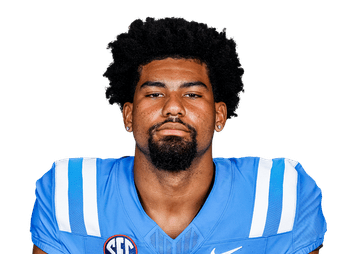
De'Zhaun
Stribling.
 Ole Miss· 6'2"· 205 lb
"Long, contested-catch X receiver whose transfer arc produced a Ole Miss breakout; the projection lives on whether the top-end speed plays in the NFL against pro press corners."Pre-draft read
The player operates cleanest as an isolated X receiver, frequently aligning to the boundary for fade, back-shoulder, and dig routes. His primary win trait is contested-catch ability, utilizing long arms, late hands, and advanced tracking skill to convert 50/50 balls into high-probability receptions. Additionally, he exhibits proficiency in intermediate route sequencing.
He effectively stacks defenders on vertical stems, executes sharp snap-downs on comeback routes, and strategically uses his frame to shield the catch point on digs and slants. While his release package against press coverage is adequate, relying more on length and body positioning than sudden footwork, his ball tracking on deep passes is a notable strength. Play speed at the top of routes against deep coverage remains an open question.
Shanahan outside zone is a run-heavy scheme that still requires receivers who can separate and win in one-on-one situations, especially on critical downs to extend drives.
Year 1: 3rd down conversion specialist and red zone target. Ceiling: long-strider X-receiver who owns the boundary.
An Air Raid system that requires receivers to generate significant YAC on short throws and consistently separate vertically will undervalue his strengths.
A possession-plus boundary receiver whose elite contested-catch ability and red-zone prowess will allow him to contribute immediately, despite questions about his top-end deep speed.
De'Zhaun Stribling (Ole Miss) — Full 2025 Highlights
Senior-year Ole Miss cut-up: contested catches, deep-ball tracking, red-zone fades.
Stribling 75-yard TD run vs Mississippi State
Signature Egg Bowl catch-and-run that pushed him into the Round 1 conversation.
De'Zhaun Stribling Highlights — 2026 NFL Draft
Pre-draft cut-up focused on X-receiver skill set and route-tree usage across three programs.
This prospect profiles as a long-strider X receiver with a proven ability to excel in contested-catch situations. A team drafting him is buying a player who can be deployed in isolation schemes to win 50/50 balls and provide a reliable target for critical third-down conversions and red-zone opportunities. His projection ultimately hinges on whether his deep speed translates to consistent vertical separation against professional defensive backs.
His collegiate career involved transfers between three schools, culminating in his most impactful season within a scheme designed around isolation routes. He consistently demonstrated reliable hands and a significant red-zone presence across multiple programs. A key moment in his evaluation was a 75-yard touchdown, tracking a post against an All-SEC safety, which reignited discussions about his vertical play speed.
Evaluators consistently flagged two primary concerns: the question of whether his deep speed would genuinely translate to the NFL level, and whether his multi-program transfer history indicated underlying developmental issues. Despite these questions, consensus had him as a Day 2 prospect, with some teams moving him into the Round 1 conversation, ultimately leading to him being drafted 33rd overall.
- 01
Contested-catch dominance
long arms, late hands, and precise body-positioning transform 50/50 balls into completions at a superior rate compared to many peers.
- 02
Ball-tracking on deep shots
genuinely elite ability to track over-the-shoulder passes, adjusting to underthrows without losing speed and consistently finishing through contact.
- 03
Red-zone weapon
displays effective fade and back-shoulder techniques inside the 10-yard line, proving adept at securing catches along the sideline.
- 04
Intermediate route sequencing
accurately stacks defenders on the vertical stem and snaps down on comeback routes with precise timing, sustaining high third-down conversion rates.
- 05
Transfer-portal survivor
successfully navigated three collegiate programs, showing progressive statistical improvement each year without maturity flags on tape.
- 01
Deep-speed projection
while tape shows flashes of top gear, his timed splits typically fall within the average range, raising questions about vertical separation against NFL press coverage.
- 02
Release package vs press
relies mostly on length and body lean to beat press, which can be exploited by long and physically strong cornerbacks who can reroute him.
- 03
Burst off the line
exhibits average initial acceleration through the first ten yards, limiting his ability to gain free access against off coverage in quick game scenarios.
- 04
YAC creation
his long-strider frame results in limited elusiveness after the catch, profiling him more as a possession-plus receiver than a player creating significant yards after the catch.
| Yr | Team | G | Rec | Yds | TD |
|---|---|---|---|---|---|
| 2021 | Washington State | 13 | 44 | 471 | 5 |
| 2022 | Washington State | 12 | 51 | 602 | 5 |
| 2023 | Oklahoma State | 4 | 15 | 201 | 1 |
| 2024 | Oklahoma State | 11 | 52 | 892 | 6 |
| 2025 | Ole Miss | 15 | 55 | 811 | 6 |
| Career | — | 55 | 217 | 2977 | 23 |
A dash means the figure is not published by a source we trust — never a zero we invented.
- Trinidad ChamblissQB24%
- Austin SimmonsQB15%
- Harrison Wallace IIIWR9%
#5 of 19 tracked contributors · Production leaned on volume · Offense explosiveness 1.28 (p67) · CFBD — usage x PPA per tracked player
Isolated X in a play-action offense whose length and tracking play up as a WR2 without ever quite breaking through as a burner.
Long X who wins on contested catches, intermediate route timing, and third-down reliability more than vertical explosion.
Long-strider contested-catch profile whose average NFL separation caps him below his college-tape ceiling.
Everything above is the pre-draft evaluation. This section is what actually happened — updated year over year.
Pre-draft context: Long, contested-catch X receiver whose three-school arc — Washington State to Oklahoma State to Ole Miss — culminated in a scheme-fit senior year under an offensive system emphasizing offensive talent. Around 6'2", 205 pounds with long arms and rare tracking, Stribling put together a career-best statistical season on efficient targets and moved himself from a Day 3 conversation into the top of Round 2. The board consensus revolved around two flags: whether the deep speed is real NFL long-speed against pro press, and whether the transfer arc masked development questions. His 75-yard Egg Bowl touchdown over an All-SEC safety recentered the vertical-separation question and pulled him into the Round 1 conversation for a handful of teams.
NFL fit — San Francisco 49ers: San Francisco took Stribling at 33 to add an isolation-route X to a receiver room that has leaned heavily on YAC creators and slot separators. The fit reads clean on early downs: San Francisco already deploys condensed sets that put an X on the backside of run action, and Stribling's tracking and body-positioning tools translate directly to the boundary post and back-shoulder concepts that structure asks its quarterback to throw. Whether he grows into a full-time WR2 depends on two things — whether the release package expands enough to beat NFL press without gadgetry, and whether the deep-speed projection actually plays in a Shanahan vertical shot game where separation matters more than tracking. Contested-catch production and third-down reliability should show up week one; the pivot toward YAC volume is where the player development team will need to grow him.
Retrospective: Too early for a career call — Stribling is a July 2026 rookie whose first camp starts weeks from this profile. The evaluation to track: does the deep speed play against NFL press, or does he settle in as a possession-plus X with red-zone reliability but limited vertical footprint? The floor is a five-year rotational X with real third-down and red-zone value; the ceiling is a Pittman-style volume WR2 whose tracking and length outrun his 40 time.