
Tre
Harris.
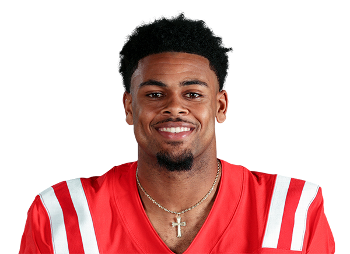
Tre
Harris.
 Ole Miss· 6'2"· 205 lb· 4.54s 40
"This big-bodied X-receiver, whose 70/30 contested catch rate and absurd per-game production flourished even after jumping to the SEC, could be an immediate red-zone weapon if his limited route tree and durability concerns are mitigated."Pre-draft read
Big-bodied boundary X who lived on the perimeter in Ole Miss's spread and won the ball in the air, not on the ground. Long-strider who builds to speed instead of exploding, so his separation shows up late in the rep — at the top of the stem, on the back shoulder, at the catch point where he uses a rebounder's timing to box out and pluck outside his frame.
Second gear is a stride length, not a burst, and that shapes everything: he beats zone with size and spacing, not man with quickness. Physical enough to shrug press once he gets hands on, but his release package is repetitive. The signature is contested volume — throw it up in a one-on-one anywhere from the numbers to the sideline and he wins more of those than his testing suggests.
Vertical play-action offense that isolates an X receiver on the boundary and lets him win the ball on go, back-shoulder and red-zone fades.
Year 1: contested-catch specialist and red-zone target on the outside. Ceiling: legitimate No. 2 X who commands single coverage on early downs.
Timing-based horizontal quick game that asks him to win instantly off the snap on slants and option routes against tight press.
He is a ball-winner, not a separator — the scheme has to throw him open above the rim.
Tre Harris || Ole Miss Rebels Wide Receiver || 2024 Senior Highlights
Full 2024 senior reel: boundary go-balls, back-shoulder wins and contested finishes.
2nd Round Pick WR Tre Harris College Highlights | LA Chargers
Chargers-cut draft reel highlighting his catch radius and red-zone jump-ball work.
2025 NFL DRAFT HIGHLIGHTS: Tre Harris | WR | Ole Miss
Draft-cycle cutup showing release limitations against press alongside vertical tracking.
A converted high school quarterback who arrived at Louisiana Tech as a two-star and left Oxford as a second-team All-American, Harris is the rare small-school-to-SEC riser whose tape got better every stop. Football identity is simple and stable: an outside receiver who plays big, catches everything in his radius and turns 50/50 balls into 70/30 balls.
Production backed it up. He went 65-935-10 in his final Conference USA season, then 54-985-8 in his first SEC year, then averaged 128.8 receiving yards per game across eight 2024 appearances before a groin injury cost him three games and lingered into the Florida game. That per-game rate was the best in the country among high-volume receivers, and he closed with 134 yards on Penn State in the Peach Bowl. The flags: a thin route tree in the team's offensive system, a 4.54 forty that read as functional rather than explosive, and durability questions from the groin.
Boards had him as a fringe top-50 to early-second value — consensus around No. 63, CBS at No. 70 and eighth receiver. Los Angeles taking him 55th was a needs-based swing at the big perimeter target their offense lacked next to Ladd McConkey, and a bet that the catch radius travels even if the separation profile is modest.
- 01
Catch point dominance
plays the ball like a rebounder, high-points through contact and consistently converts contested targets outside his frame.
- 02
Hands and tracking
natural plucker with reliable deep-ball location over either shoulder, comfortable adjusting to back-shoulder and off-platform throws.
- 03
Frame and play strength
6-2 3/8, 205 with the density to absorb contact through the route and finish catches with a defender draped on him.
- 04
SEC production curve
went from Conference USA standout to 128.8 receiving yards per game in 2024, the best rate among high-volume Power Four receivers.
- 05
Vertical explosion
38.5-inch vertical and a 10-foot-5 broad give him a real ceiling on jump-ball and red-zone throws above the rim.
- 01
Release package
repetitive and narrow against press, leans on physicality instead of varied footwork and hand usage to defeat a quick jam.
- 02
Burst off the line
long-strider who builds speed rather than exploding into it, which lets corners stay in phase through the first 10 yards.
- 03
Route tree
Kiffin's system asked for a small menu of verticals, hitches and slants, so intermediate breaking-route reps are largely unproven.
- 04
Durability
the 2024 groin injury cost him three games and reaggravated against Florida, capping his final college season at eight appearances.
— — — positional median (p50)
- 40 yd
- 4.54sp50
- Vertical
- 38.5inp50
- Broad jump
- 125inp50
- Three-cone
- —s
- Shuttle
- —s
- Bench
- —rep
| Yr | Team | G | Rec | Yds | TD |
|---|---|---|---|---|---|
| 2020 | Louisiana Tech | 7 | 1 | 20 | 0 |
| 2021 | Louisiana Tech | 12 | 40 | 572 | 4 |
| 2022 | Louisiana Tech | 12 | 66 | 954 | 10 |
| 2023 | Ole Miss | 12 | 54 | 985 | 8 |
| 2024 | Ole Miss | 8 | 61 | 1063 | 7 |
| Career | — | 51 | 222 | 3594 | 29 |
A dash means the figure is not published by a source we trust — never a zero we invented.
- Jaxson DartQB31%
- Cayden LeeWR8%
- Jordan WatkinsWR8%
#2 of 19 tracked contributors · Produced in line with his snap share · Offense explosiveness 1.36 (p90) · CFBD — usage x PPA per tracked player
Dependable rotational outside receiver whose value is situational rather than as a target earner.
The realistic best case: a big-framed X who becomes a target-hog on volume and contested work.
Fourth receiver who never carves out steady snaps because the separation never arrives.
Everything above is the pre-draft evaluation. This section is what actually happened — updated year over year.
Los Angeles played him exactly as drafted: a big perimeter body in three-receiver sets who worked the boundary while Ladd McConkey ran the middle of the field. Harris opened the 2025 season in the rotation, played 16 of 17 regular-season games and finished with 30 catches for 324 yards and one touchdown, adding two catches for 20 yards in the wild-card loss at New England. The volume never spiked — his season high was four receptions — and the yards-per-catch fell to 10.8, a long way from the 17.2 he averaged in Oxford. That number tells the story of his usage: he was a possession and situational body in a Justin Herbert offense that funneled its explosive plays elsewhere.
In hindsight the pick still reads as fair value rather than a hit or a miss. The trait that made him a second-rounder — winning above the rim on the boundary — showed up rarely because the targets were short and the route menu stayed narrow, the same limitation that flagged him coming out. He was not exposed athletically and he did not lose the job. Year two, with a full offseason and a defined role, is the real referendum.