
Shemar
Stewart.
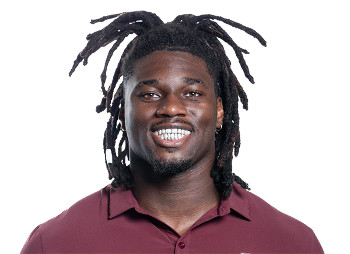
Shemar
Stewart.
 Texas A&M· 6'5"· 267 lb· 4.59s 40
"A movement-skills base end whose value case rests on displacement and length rather than a finished rush plan, in the mold of a young Danielle Hunter asked to grow into production."Pre-draft read
Primarily a left-side base end in a four-man front, the player slides inside to a three-technique in sub packages. The primary trait is raw explosiveness off the ball, and the secondary trait is length-driven separation, as he extends and sheds to reset the line of scrimmage against down blocks and reach attempts. His get-off and mass create immediate interior displacement.
Hands are heavy but sequenced late; the punch lands after the tackle has set rather than into the rise, which is why many wins end as a hurry instead of a sack. Feet are clean on the initial two steps and stiffer through the corner, causing the rush arc to flatten into the tackle rather than under him. He is far more advanced against the run than as a passer, utilizing a rare athletic ceiling.
The Cincinnati Bengals employ a base 4-3 defense with a four-man penetrating front that emphasizes disciplined run fits and attacking inside gaps.
Stewart projects as a Year 1 rotational base end with significant sub-package interior rush upside, eventually developing into an impactful starter who excels against the run and provides consistent pressure.
A two-gap 3-4 scheme that asks him to hold the point of attack for extended periods rather than immediately attacking upfield.
His rare athletic profile and run-stuffing ability make him a high-upside prospect for a team willing to develop his pass-rush technique.
Shemar Stewart College Football Highlights | Texas A&M EDGE
Career cut-up showing the get-off, long-arm and run-defense reps that carried the first-round case.
Shemar Stewart | 2024 Highlights
Final college season, including the interior alignments on passing downs and the 5.5 tackles for loss.
Shemar Stewart 2025 NFL Scouting Combine workout
Indianapolis testing: 4.59 forty, 1.58 ten-yard split, 40-inch vertical and 10-11 broad jump at 267 pounds.
This defensive end projects as an explosive power-rushing base end, valued for his rare athletic ceiling and strong run defense. While his college production was thin, particularly in sacks, his physical traits and impressive athletic testing positioned him as a first-round talent, offering teams immediate impact against the run and significant development potential as a pass rusher.
Texas A&M deployed him primarily as a five-technique in base defenses and as a reduced interior rusher on passing downs. This usage suppressed one-on-one edge opportunities, which in turn inflated his run-defense sample. He accumulated 11.0 career tackles for loss, predominantly as a two-gap disruptor, and was a key part of a front that stuffed 23.7% of 2024 runs.
Evaluators were divided between his undeniable athletic traits and his low sack production. His career total of 4.5 sacks across 37 games was a significant flag, indicating issues with converting pressures. Despite this, he landed 17th overall, aligning with the projection of teams prioritizing traits and athletic upside.
- 01
Rare First-Step Quickness
First-step quickness at 267 pounds is genuinely rare, timing snap counts well to beat guards and force early hand-fighting.
- 02
Arm Length and Extension
34 1/8-inch arms let him lock out and stay clean at the point of attack, controlling blocks against SEC run games.
- 03
Effective Run Defender
His 11.0 career tackles for loss came as a two-gap disruptor, holding the edge against tight-end surfaces and spilling pullers inside.
- 04
Positional Versatility
Texas A&M used him from the five-technique to a reduced three, and he added interior push on passing downs to stuff 23.7% of runs.
- 05
Outlier Athleticism
A 4.59 forty, 40-inch vertical, and 10-11 broad jump at his size represent an outlier workout profile nearing the top of his class.
- 01
Low Sack Production
Just 4.5 sacks across 37 games, with 1.5 in each college season, an output curve that never rose alongside snap count or traits.
- 02
Limited Rush Plan
The repertoire stops at speed-to-power and a long-arm, lacking counters once tackles absorb the initial charge.
- 03
Late Hand Timing
His punch arrives late and often outside the frame, allowing tackles to get inside hand fixed, turning wins into stalled pressures.
- 04
Average Bend
Ankle and hip flexibility through the top of the rush arc is average, causing him to flatten into the tackle.
— — — positional median (p50)
- 40 yd
- 4.59sp50
- Vertical
- 40inp50
- Broad jump
- 131inp50
- Three-cone
- —s
- Shuttle
- —s
- Bench
- —rep
| Yr | Team | G | Tkl | Sk | Int | PD | FF |
|---|---|---|---|---|---|---|---|
| 2022 | Texas A&M | 12 | 23 | 1.5 | 0 | 0 | 0 |
| 2023 | Texas A&M | 13 | 11 | 1.5 | 0 | 2 | 0 |
| 2024 | Texas A&M | 12 | 31 | 1.5 | 0 | 2 | 0 |
| Career | — | 37 | 65 | 4.5 | 0 | 4 | 0 |
A dash means the figure is not published by a source we trust — never a zero we invented.
Honors
- No. 1 edge rusher in the 2022 recruiting class (247Sports)
- 2025 Senior Bowl invitee
- 2024 Texas A&M team captain-level rotation starter along the defensive front
A sturdy every-down base end who sets a hard edge against the run and produces mid-single-digit sacks off pressure volume rather than a refined plan.
The optimistic path: a raw, long, explosive early-entry end who added a counter package in year three and turned traits into double-digit sacks.
The cautionary path: a workout profile that never translated because the hand usage and rush plan stayed exactly where they were in college.
Everything above is the pre-draft evaluation. This section is what actually happened — updated year over year.
Few first-round selections in recent memory carried a wider gap between what the tape promised and what the box score delivered. Shemar Stewart arrived at Texas A&M as the top-rated edge rusher in his recruiting class and left three years later with 4.5 sacks, a number that would ordinarily end a first-round conversation before it started. It did not, because everything around the number argued the other way. He was asked to play a five-technique in base defenses and to reduce inside on passing downs, alignments that trade one-on-one rush chances for run-fit responsibility, and he handled the assignment with length and leverage that few in the class could match. Evaluators who leaned on context saw a player whose usage capped his output; evaluators who leaned on results saw three straight seasons of exactly 1.5 sacks and asked why the traits never found the quarterback.
Indianapolis widened the split. A 4.59 forty, a 1.58 ten-yard split, a 40-inch vertical and a 10-foot-11 broad jump at 267 pounds with 34 1/8-inch arms formed one of the loudest workout profiles the position has produced, and it hardened the trait-first case into a top-twenty grade. Cincinnati took him 17th overall to add a base end who could set an edge immediately while the rush plan caught up. The rookie year then went sideways in ways that had nothing to do with football: a contract standoff over guarantee language kept him out of the offseason program until late July, and he arrived to camp behind. He appeared in the rotation, recorded 11 tackles and a single sack, suffered a knee injury in Week 9 against Chicago, spent five weeks on injured reserve and returned in Week 16. That is an incomplete first chapter rather than a verdict. The evaluation that got him drafted still holds — the hands need to arrive on time and a counter needs to exist — and neither question was answered in 2025.