Grey
Zabel.
Grey
Zabel.
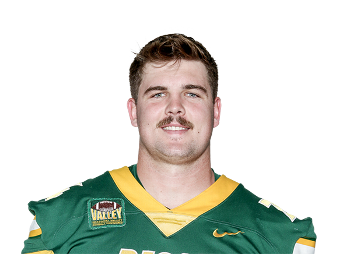
 North Dakota State· 6'6"· 312 lb
"A five-position offensive lineman whose value comes from movement skill and finish rather than raw mass, in the mold of a small-school tackle who becomes an immediate plus starter once he kicks inside to guard."Pre-draft read
This interior lineman demonstrates a play style centered on athleticism and movement, excelling in zone and gap-scheme concepts. He shows quick and accurate hands inside the frame, maintaining footwork through contact, and effectively scanning for twists or late pressure. His primary trait is reach and redirect in space, where he consistently climbs to the second level, adjusts to moving linebackers, and finishes with intent.
His pass protection relies on technique rather than arm length. While a college left tackle, his athletic profile and technique translate well to interior line play. He shows positional flexibility, performing without a drop-off across multiple line assignments.
Pete Carroll's approach to offense is often a run-heavy wide zone or outside zone system that leverages the mobility of its interior players.
Year 1 impact starter at guard with the athletic ceiling to become a Pro Bowl center in a flow-heavy scheme.
A pure gap/duo power run game where he would be asked to anchor against constant double teams without the opportunity to move and redirect.
Zabel's agility and movement skills make him a natural fit for zone schemes, allowing him to climb to the second level and execute reach blocks effectively.
Grey Zabel College Football Highlights | NDSU Left Tackle | NFL Draft Film
Senior-year tape from Fargo: reach blocks, second-level climbs and the finish that defined the FCS All-America season.
Grey Zabel Senior Bowl Highlights | 2025 NFL Draft
Mobile reps against Power Four competition at guard and center, the week that turned a small-school evaluation into a first-round grade.
Grey Zabel | Offensive Tackle | NDSU | 2025 NFL Draft Target Highlights
Full pre-draft cut-up showing pass sets, hand placement and the positional versatility across the offensive line.
Grey Zabel entered the draft as a position-flexible interior lineman, projected to bring a zone-scheme mauler mentality. Teams saw a player with an athletic profile suitable for moving rather than solely power-blocking, highlighted by a 4.60 short shuttle at 312 pounds. The core projection centered on his ability to excel in space and his technical proficiency. His versatility was a key selling point.
He played five seasons at North Dakota State, accumulating 41 starts across four different positions: left tackle, right tackle, left guard, and right guard. As a senior, he earned first-team FCS All-American honors at left tackle. The evaluation focused on where he would best fit in the NFL due to his varied college usage and the FCS competition level. Senior Bowl week demonstrated his capability against higher-tier defensive linemen, solidifying a top-20 projection.
The primary concern for Zabel was his 32-inch arm length, which pushed consensus evaluators to project him as an interior lineman, limiting his tackle potential. The jump from FCS competition also raised questions about his anchor against professional power rushers and his ability to adapt to a primary guard role, having only started four college games at guard. Despite these flags, he was drafted by the Seattle Seahawks with the 18th pick.
- 01
Positional flexibility
Started at left tackle, right tackle, left guard and right guard in college and took center reps at the Senior Bowl, a five-position floor few linemen can claim.
- 02
Athletic testing
A 4.60 short shuttle, 7.66 three-cone and 36.5-inch vertical at 312 pounds put him among the most agile offensive linemen tested in the entire 2025 class.
- 03
Movement blocking
Reaches defenders on the backside of zone, climbs cleanly to linebackers and adjusts on the move, the skill set that anchored a top-five FCS rushing attack.
- 04
Pass-protection efficiency
Allowed one sack across 752 regular-season reps as a senior while grading out at 93%, with only two penalties in twelve games.
- 05
Durability and availability
Played 62 games over five seasons and started the final 36 consecutive contests of his career, missing no time from 2022 onward.
- 01
Arm length
32-inch arms sit below the functional threshold most teams set for tackles, forcing the interior projection and shrinking the number of ways he can be deployed.
- 02
Competition tier
Every rep of college tape came against FCS opponents, so the anchor and hand strength questions could only be answered in all-star and pre-draft settings.
- 03
Anchor versus power
Gets walked backward by true bull rushers when his pads rise, a concern amplified by the jump in nose-tackle mass he would face on the interior.
- 04
Position change
Never started a college game at center and started only four at guard since 2021, so the pro role required relearning footwork, splits and interior communication.
— — — positional median (p50)
- 40 yd
- —s
- Vertical
- 36.5inp50
- Broad jump
- 111inp50
- Three-cone
- 7.66sp50
- Shuttle
- 4.60sp50
- Bench
- 26repp50
| Yr | Team | G |
|---|---|---|
| 2020 | North Dakota State | 5 |
| 2021 | North Dakota State | 11 |
| 2022 | North Dakota State | 15 |
| 2023 | North Dakota State | 15 |
| 2024 | North Dakota State | 16 |
| Career | — | 62 |
A dash means the figure is not published by a source we trust — never a zero we invented.
Honors
- First-team FCS All-American (2024)
- First-team All-MVFC (2024)
- Two-time FCS national champion (2021, 2024)
- Two-time MVFC Offensive Lineman of the Week (2024)
- 2025 Senior Bowl invitee
The realistic path: a small-school interior lineman with rare agility for his mass who becomes a decade-long starter in a zone-heavy running scheme.
The optimistic path: a college tackle whose length pushed him inside, where the athleticism and hand accuracy made him an immediate Pro Bowl-caliber guard.
The floor is unusually high for the profile — a Division III convert who still started immediately; the risk is a swing role rather than a fixed one.
Everything above is the pre-draft evaluation. This section is what actually happened — updated year over year.
The most common way a small-school offensive lineman gets drafted in the first round is by looking undeniable against the few good players he faces. Grey Zabel did it the harder way. He spent five years in Fargo starting at four different positions, finished as a first-team FCS All-American at left tackle for a national champion, and then went to Mobile and proved the tape against people who would be drafted alongside him. Senior Bowl week was the hinge of the entire evaluation: he took snaps at center, at both guard spots, and held up against Power Four interior linemen who outweighed him. By the time the week ended, the conversation had shifted from whether the competition tier disqualified him to which interior position suited him best.
The flag that never went away was arm length. Thirty-two inches is short for a tackle, and every room that liked him had already moved him inside before the Combine confirmed the number. That relocation did not cost him much, because the traits that made him worth a first-round pick — a 4.60 shuttle and 7.66 three-cone at 312 pounds, clean climbs to the second level, hands that arrive inside the frame — travel better to guard than to tackle anyway. The honest concerns were anchor against pro-caliber bull rushers and the mechanics of a position he had barely played since his freshman spring.
Seattle answered both quickly. He started all seventeen regular-season games as a rookie, added three more starts in the playoffs, made the PFWA All-Rookie Team and finished the year blocking in a Super Bowl LX victory over New England. For a prospect whose entire file was framed as a projection, the first season removed almost all of the doubt.