
Derrick
Harmon.
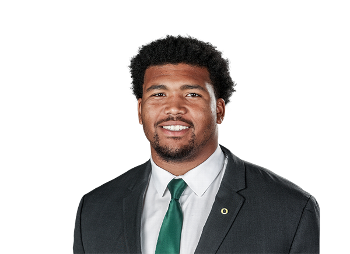
Derrick
Harmon.
 Oregon· 6'5"· 313 lb· 4.95s 40
"A long-armed interior disruptor whose value comes from pushing the pocket rather than filling a gap, the kind of five-technique-to-three-technique hybrid teams draft to make a good front better on third down."Pre-draft read
Harmon aligns from zero to a wide shade and wins with length before quickness, using his long arms to lock out and reset the line of scrimmage on first contact. His primary trait is raw power through the hands, specifically a long-arm that stalls guards in their tracks and a bull rush that collapses pocket depth. The secondary trait is a sudden inside counter off that power, a club-swim he uses when a blocker oversets.
His feet churn well on contact, eyes remain in the backfield, and he sheds late but violently against gap runs. Against the pass, he prioritizes pushing the pocket over finishing with a sack, which leads to a higher volume of hurries than sacks. His athletic ceiling is defined more by strength and length than by bend, and he rarely loses ground once a block is engaged.
Pittsburgh's one-gap 3-4 penetrating front. He is a good fit for their defensive scheme, relying on strong, disruptive defensive linemen to free up their linebackers.
Harmon projects as a rotational interior lineman in Year 1, with the ceiling to become a long-term starter at nose tackle or 3-technique.
He would be less effective in a two-gap 3-4 system that asks linemen to read and react to blocks rather than aggressively penetrate gaps.
With his length, power, and alignment flexibility, Harmon is a strong scheme fit for Pittsburgh, allowing him to disrupt upfront and create opportunities for their blitzing linebackers.
Derrick Harmon | Defensive Tackle | Full 2024 Oregon Highlights
Full-season cutup of the Oregon breakout year, the tape the first-round grade was built on.
Derrick Harmon - DL - Oregon | All-22 Film Study
All-22 breakdown of the long-arm and the inside counter across different interior alignments.
Derrick Harmon Full NFL Debut Highlights | All Snaps vs Patriots
Every snap of the delayed rookie debut in Week 3 of 2025, including his first professional sack.
Derrick Harmon projects as a long-armed power three-technique, capable of holding the point in the run game and collapsing the pocket as a pass rusher. A team acquiring him expected an immediate impact as an interior disruptor who wins with leverage and raw strength, particularly his ability to extend and control blockers at the point of attack. His 34 3/8-inch arm length was a key measurable.
Harmon spent three years as a rotational player at Michigan State before transferring to Oregon in 2024. In his single season at Oregon, he started every game for a Big Ten champion, leading the team in pressure production. He accumulated 10.5 tackles for loss and 5.0 sacks while demonstrating alignment flexibility across the defensive front. This breakout performance followed seasons where he accumulated only 3.5 combined sacks at Michigan State.
Evaluators were impressed by his length, play strength, and consistent hurries, but significant flags included his one-year sample of high-level production, a tendency for his pad level to rise when fatigued, and late hand timing against quicker blockers. Boards varied from late first to early second round, with the Pittsburgh Steelers ultimately drafting him at pick 21 to bolster their interior defensive line.
- 01
Length as a weapon
34 3/8-inch arms let him lock out and control the blocker's frame first, so he plays on his terms and can disengage without having to lose ground to reset.
- 02
Pocket collapse
His bull rush moves guards backward instead of sideways, taking away step-up lanes and forcing quarterbacks off the spot even on snaps that never show up as sacks.
- 03
Pressure volume
Ten quarterback hurries in 2024 on top of 5.0 sacks, an unusually high rate of disruption for an interior lineman with only one season as a full-time starter.
- 04
Alignment flexibility
Oregon lined him up from nose shade to wide five, and he held the point inside on early downs while still being trusted as a rusher on obvious passing downs.
- 05
Play strength versus doubles
Sinks his hips and splits the seam between guard and center, holding ground against combo blocks well enough to keep a linebacker clean behind him.
- 01
One-year sample
Three seasons at Michigan State produced 3.5 combined sacks and no starting-caliber tape, so the entire first-round evaluation rests on a single breakout campaign in 2024.
- 02
Pad level fatigue
His base rises in the fourth quarter and on extended drives, and taller pads let quicker interior blockers get under him and wall him off from the rushing lane.
- 03
Late hand timing
Against blockers who fire out first, his strike arrives a beat behind, and he ends up absorbing the block and playing catch-up rather than dictating the rep.
- 04
Limited bend
He corners stiffly, so pursuit outside the tackle box and chase plays down the line are not part of his game.
— — — positional median (p50)
- 40 yd
- 4.95sp50
- Vertical
- —in
- Broad jump
- —in
- Three-cone
- —s
- Shuttle
- —s
- Bench
- —rep
| Yr | Team | G | Tkl | Sk | Int | PD | FF |
|---|---|---|---|---|---|---|---|
| 2021 | Michigan State | 4 | 1 | 0 | 0 | 0 | 0 |
| 2022 | Michigan State | 12 | 28 | 2 | 0 | 1 | 0 |
| 2023 | Michigan State | 12 | 40 | 1.5 | 0 | 1 | 0 |
| 2024 | Oregon | 14 | 43 | 5 | 0 | 2 | 0 |
| Career | — | 42 | 112 | 8.5 | 0 | 4 | 0 |
A dash means the figure is not published by a source we trust — never a zero we invented.
Honors
- Second-team All-Big Ten (2024)
- Second-team Associated Press All-American (2024)
- Big Ten champion (2024)
A sturdy every-down interior starter who is more consistent pressure than gaudy sack totals and holds up against the run on early downs.
The length-plus-power template taken to its ceiling: an interior rusher who wins with reach and relentlessness and becomes the centerpiece of a front.
A rotational power rusher who flashes on third down but never separates from the committee because the counters and the finishing never fully arrive.
Everything above is the pre-draft evaluation. This section is what actually happened — updated year over year.
Missed the first two weeks of his rookie year with a preseason MCL sprain, then started eight of his 12 appearances for Pittsburgh, posting 27 tackles and 3.0 sacks plus a sack in his only playoff game, and was voted the team rookie of the year.
The first three years of Derrick Harmon's college career explain why the fourth one made scouts nervous. He arrived at Michigan State as a heavyset three-star from Detroit Loyola, redshirted, and then spent two seasons as a body in a rotation with no fixed job — some nose, some three-technique, occasional five, never enough of any one thing to build an identity. He put his name in the transfer portal after 2023, pulled it back out a month later, and then left for Oregon anyway in May 2024. What happened next was the fastest kind of ascent in this sport: one season of clean, defined usage in a front that let him rush from advantageous alignments on third down, and a rotational Big Ten body became a first-round pick. He started all 14 games for a team that went unbeaten in the regular season, and his disruption showed up in the aggregate as much as the box score, on a defense whose 19.3 percent havoc rate leaned heavily on interior penetration.
The evaluation always came down to the same question: is one year of production a foundation or a fluke? The traits argued for the former. Harmon's arms measure 34 3/8 inches, and he uses them the way the best interior rushers do — extending first, controlling the blocker's chest, then working off the lock rather than into it. His bull rush is a genuine pocket collapser, and Oregon's 38.2 percent defensive success rate reflected how often plays died before they developed in front of him. The concerns were mechanical rather than physical: pads that climbed late in games, hands that arrived a tick behind against blockers who fired out first, and a finishing move that never quite matched the pressure volume. Pittsburgh bet on the traits at 21, then watched him sprain an MCL in the preseason finale and miss the opening month. When he returned, the fit was obvious. He started eight of his 12 games, recorded 3.0 sacks, added another in the playoffs, and took home the franchise's rookie of the year award. The 2025 tape validated the profile without resolving it: still a problem to block, still learning how to finish what he starts.