
Abdul
Carter.
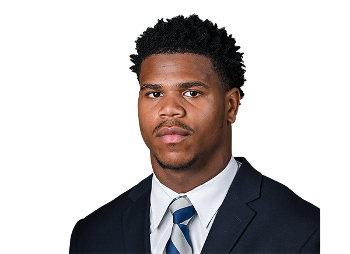
Abdul
Carter.
 Penn State· 6'3"· 250 lb
"An off-ball linebacker who moved to the edge and became the most disruptive rusher in the country, projecting as a stand-up bender in the Micah Parsons mold with a wider run-defense learning curve."Pre-draft read
Carter aligns as a wide-nine stand-up rusher who slides inside on passing downs and can still drop into hook zones on early down changeups. His primary trait is the corner turn: he flattens his ankle and shrinks his surface area at the apex better than any 250-pounder in the class, immediately beating offensive tackles who overset their kick. His secondary trait is his first step, timed off the ball rather than the snap count, forcing linemen into hurried recovery. Hands are quick but still developing a counter package; the long arm and cross-chop show up more than a true rip or spin.
Against the run he is a slasher, winning on penetration rather than stack-and-shed leverage; heavier tight ends can wall him off. The separator is his off-ball background: he can drop, spy, and blitz from depth.
A one-gap penetrating 3-4 scheme, which values versatility and attacking upfield from multiple alignments.
Year 1 rotational pass rusher with sub-package versatility, transitioning to a full-time impact starter with double-digit sack potential and defensive playmaking.
A two-gap 3-4 system that asks its outside linebackers to consistently set the edge against tackles and heavier tight ends, as his run defense involves slashing rather than stack-and-shed.
A highly athletic and versatile edge rusher with an elite bend and first step, perfectly suited for a scheme that prioritizes upfield penetration and diverse alignments, but with some developmental needs in run defense and counter moves.
Abdul Carter Full College Highlights — Penn State EDGE
Career cut showing the corner turn, the long arm and the off-ball drops from his linebacker years.
Abdul Carter vs Donovan Jackson — Full Matchup
Every rep against Ohio State's first-round tackle, the cleanest read on his hand use and counters.
Abdul Carter 2025 NFL Draft Prospect Film Breakdown
Coaching-tape study of his get-off timing, ankle flexion and run-defense leverage.
Carter projects as a bend-first stand-up edge rusher, a role a team buys for his ability to turn the corner and reduce his surface area at the apex. The profile is built on the belief that his pass-rush traits translate to a full-time position, even with limited experience there. His production spike came in his first full season at the position, making him a high-upside prospect who had not yet reached his ceiling.
Penn State used Carter as an off-ball linebacker for two seasons before moving him to edge full-time in his third year. This transition led to him leading the country with 24 tackles for loss and adding 12 sacks over 16 games. This contextualizes his production, as he achieved a dominant season with limited true hand-in-the-dirt rushing snaps, which evaluators saw as potential for further development, not a fully maxed-out player.
Concerns during the evaluation included a stress reaction in his right foot, which prevented him from participating in combine or pro day testing, leaving teams to rely on game film for athletic assessment. An off-field misdemeanor assault charge required extensive character evaluation. Despite these flags, consensus boards viewed him as a top non-quarterback prospect, and the Giants selected him third overall.
- 01
Corner flattening
He drops his inside shoulder and shrinks at the apex as well as anyone in the class, turning a wide alignment into a direct line at the quarterback.
- 02
First-step timing
He anticipates the ball rather than the cadence, and the resulting head start put Big Ten tackles into recovery mode before their second kick step landed.
- 03
Production spike
In his first season as a full-time edge he led the nation with 24 tackles for loss and added 12 sacks over 16 games, a workload no one on his front matched.
- 04
Coverage background
Two years off the ball left him comfortable dropping to a hook zone, spying mobile quarterbacks and blitzing from depth on delayed pressure looks.
- 05
Closing burst
Once he clears the tackle's outside hand the chase speed is a separate weapon; he ran down plays from the backside and forced five career fumbles doing it.
- 01
Counter package
The long arm and cross-chop carry the plan, and when tackles take away his outside track he lacks a reliable inside spin or rip to answer.
- 02
Run-defense leverage
He slashes rather than stacks, and heavier tight ends on down blocks can wall him from the point of attack before he reads the flow.
- 03
No verified testing
A stress reaction in his right foot found at the combine shut down every workout, so no team had timed speed or explosion numbers before the pick.
- 04
Off-field flag
A spring 2024 misdemeanor assault charge resolved through pre-trial intervention forced every board to run its own character work before setting a grade.
| Yr | Team | G | Tkl | Sk | Int | PD | FF |
|---|---|---|---|---|---|---|---|
| 2022 | Penn State | 13 | 55 | 6.5 | 0 | 4 | 0 |
| 2023 | Penn State | 13 | 49 | 4.5 | 1 | 5 | 0 |
| 2024 | Penn State | 16 | 62 | 12 | 0 | 4 | 0 |
| Career | — | 42 | 166 | 23 | 1 | 13 | 0 |
A dash means the figure is not published by a source we trust — never a zero we invented.
Honors
- 2024 unanimous All-American
- 2024 Big Ten Defensive Player of the Year
- 2024 national leader in tackles for loss
- 2023 and 2024 first-team All-Big Ten
- 2022 second-team All-Big Ten as a true freshman
A high-floor front-side starter whose pressure volume outruns his sack total early while the counter package fills in.
The same Penn State linebacker-to-edge path, with the bend and closing speed to post double-digit sacks from his first professional season onward.
A traits-first top-three edge who takes several years to convert athletic wins into consistent quarterback contact.
Everything above is the pre-draft evaluation. This section is what actually happened — updated year over year.
The evaluation of Carter was never about whether the tape was good. It was about how little of it existed at the position he was going to play. Penn State used him as an off-ball linebacker for two full seasons, and even in the year he led the country in tackles for loss, plenty of his snaps came from a two-point stance closer to the box than the boundary. That is unusual for a top-five defender, and it split rooms in a productive way. The pessimists saw a player whose run-defense technique lagged behind his rush ability, prone to running himself out of gaps. The optimists saw a rusher who had produced 12 sacks in his first real season of rushing, on a front seven that generated a 12.8 percent havoc rate without a second consistent pressure source. He never tested. A stress reaction in his right foot, discovered during medical checks at the combine, shut down the entire workout process, so teams graded the burst off broadcast angles and their own eyes at the Orange Bowl.
The Giants took him third and signed him to a fully guaranteed rookie deal, and his first year read like exactly the projection people wrote down in April. Through twelve games he had half a sack. He played the majority of the defensive snaps anyway, generated pressure that did not convert, and got benched twice for off-field discipline issues that reflected a rookie still learning the professional rhythm rather than anything structural. Then December arrived and he recorded at least half a sack in every game, finishing with four sacks, seven tackles for loss, two forced fumbles and two recoveries across seventeen appearances, enough for a PFWA All-Rookie nod and a fifth-place finish in Defensive Rookie of the Year voting. That is a reasonable rookie line for a converted linebacker who never had an offseason of testing. It is not yet the answer to the question the draft asked. The bend still travels. Whether the counters and the run-game discipline catch up to it is the file that stays open going into year two.