
Ty'Ron
Hopper.
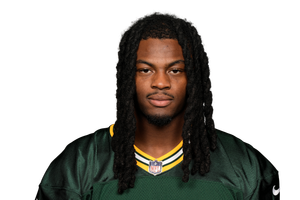
Ty'Ron
Hopper.
 Missouri· 6'2"· 231 lb
"Green Bay bet a third-round pick on a linebacker who could run with anybody, then spent two years discovering that running with anybody is not the same as playing every down."Pre-draft read
Hopper is a 6-2, 230-pound weakside linebacker who plays with his hair on fire. He lines up off the ball in even fronts, triggers the moment his run key declares, and has the closing burst to beat pulling guards to the fit. He is at his most dangerous flowing outside the tackle box, where his speed turns backside pursuit into chase-down tackles other linebackers never make.
The blitz is his best pass-rush answer: he times the snap well, presses interior gaps with a usable rip, and can carry backs and slower tight ends vertically in man. Against the run between the tackles he is more of a runner than a thumper, preferring to beat blocks with angles rather than absorb them. The signature is speed to the perimeter.
Speed-based 4-3 WILL / sub-package coverage linebacker
Year 1: core four special teams and dime coverage linebacker who blitzes on obvious passing downs. Ceiling: three-down WILL in a light, penetrating front that keeps guards off him.
Two-gap 3-4 fronts that ask an inside linebacker to take on pulling guards and fullbacks in a phone booth, or heavy zone-match systems that demand disciplined eyes and static run fits.
Needs a front seven that lets him run to the ball rather than absorb blocks.
Ty'Ron Hopper Missouri Highlights
Missouri tape showing his range to the boundary and downhill trigger.
2024 NFL Draft: Ty'Ron Hopper, LB Missouri
Pre-draft cut-up focused on blitz timing and coverage on backs.
Ty'Ron Hopper Highlights | LB 2024 NFL Draft
Career montage into his Green Bay selection.
A five-year college player who started at Florida and found himself at Missouri, Hopper is a movement linebacker whose identity is range. He never looked like a stack-and-shed defender; he looked like a defender you let run, whether that meant chasing zone runs to the boundary, matching backs out of the backfield, or pressuring the A-gap on third down.
The production followed the move. After 62 tackles in his first real starting season with the Gators in 2021, he posted 65 tackles with 13.5 for loss in 2022 and 55 more with 6.0 tackles for loss and 3.0 sacks in 2023, finishing as a Butkus Award finalist and a Senior Bowl invitee. The flags were just as consistent: eyes that drifted to the backfield in zone, a frame that got moved by guards, and tackles left on the field when he arrived high.
The board treated him as a Day 2 developmental starter with special-teams insurance — a linebacker whose athletic profile was worth a third-round bet even if the run-game details were unfinished. Green Bay taking him at 91 fit that read exactly: a defense that valued speed at the position was buying traits and coverage snaps, not a plug-and-play signal-caller.
- 01
Sideline-to-sideline range
chases plays to the boundary and makes tackles from the backside that most off-ball linebackers never get to.
- 02
Downhill trigger
reads his run key quickly and attacks the line of scrimmage without the false step that costs linebackers a gap.
- 03
Blitz value
times the snap well and threads interior gaps with a usable rip move, giving a defense a cheap third-down pressure package.
- 04
Man coverage on backs
has the speed and change of direction to carry running backs and heavier tight ends down the seam.
- 05
Special teams profile
the speed, physicality and willingness to run through contact translate immediately to all four core units.
- 01
Block deconstruction
a wiry 221-to-231-pound frame gets displaced by guards and he lacks the hand strength to stack and shed cleanly.
- 02
Zone eye discipline
stares into the backfield too often and ends up covering grass while a receiver settles behind him.
- 03
Tackling consistency
arrives high with poor pad level at times, which turns sure stops into yards after contact.
- 04
Gap discipline
over-runs interior fits when he chases speed, opening cutback lanes his range cannot always recover.
| Yr | Team | G | Tkl | Sk | Int | PD | FF |
|---|---|---|---|---|---|---|---|
| 2019 | Florida | 4 | 2 | 0 | 0 | 0 | 0 |
| 2020 | Florida | 11 | 13 | 0.5 | 0 | 0 | 0 |
| 2021 | Florida | 13 | 62 | 2.5 | 0 | 2 | 0 |
| 2022 | Missouri | 13 | 65 | 3 | 1 | 2 | 0 |
| 2023 | Missouri | 10 | 55 | 3 | 0 | 3 | 0 |
| Career | — | 51 | 197 | 9 | 1 | 7 | 0 |
A dash means the figure is not published by a source we trust — never a zero we invented.
Special-teams ace with situational coverage snaps and no fixed defensive role.
Ceiling if the run-fit details and eye discipline ever catch up to the speed.
Day 2 linebacker whose defensive workload never grows past emergency duty.
Everything above is the pre-draft evaluation. This section is what actually happened — updated year over year.
Green Bay never asked Hopper to be a defensive starter. He played all 17 games as a rookie in 2024 with two tackles on defense and a full special-teams workload, then repeated the pattern in 2025 with 17 more appearances, 12 tackles, a forced fumble and steady core-four snaps. Two years in, he had 34 games played and roughly 14 career tackles — a special-teams contributor whose defensive role never expanded past emergency work behind a linebacker room the Packers kept adding to.
In hindsight, the pick reads like a traits bet that never got the runway. Hopper was drafted for range and coverage speed, but the run-game concerns scouts flagged — the frame, the eyes, the pad level — were exactly the reasons a coordinator does not put him on the field on early downs. He has been useful and durable, and third-round special-teams cores are not worthless, but 91 is a slot where teams expect defensive snaps. Unless the depth chart opens, this stays a role-player return on a starter-priced pick.