
Taliese
Fuaga.
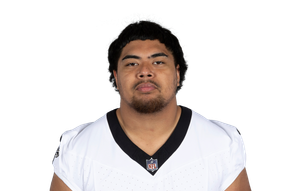
Taliese
Fuaga.
 Oregon State· 6'6"· 324 lb· 5.13s 40
"Fuaga is the rare tackle whose calling card is displacement: he lands first, walks the defender off the spot and finishes the rep, and the only real question was whether that violence would survive alone on an island."Pre-draft read
Fuaga blocks like a run-game bully who happens to be athletic enough to survive on the edge. He fires off low, lands the inside hand first and keeps his feet churning through contact, and the tape is full of down blocks that erase a three-technique and combination blocks that end with a linebacker on the ground. Gap and duo concepts are where he is most violent.
In pass protection he wins with grip strength and a wide, stable base instead of premium range. The set is compact, he absorbs speed-to-power without conceding ground, and he re-fits fast when the first punch misses. Pure edge speed and inside counters are the tax: against those rushers he catches and recovers more often than he dictates the rep.
Gap and duo-heavy run games with play-action off it; any offense that asks its tackles to displace bodies rather than reach and run.
Day-one starting right tackle in a physical run scheme, with the frame and hands to kick inside to guard if the pass-protection range ever caps him outside.
A pass-heavy, empty-set offense that leaves its tackles alone on deep drops against premium speed rushers with no chip or slide help.
New Orleans stretched the projection to left tackle as a rookie and it held, but the run-first, gap-scheme fit is where his tape is dominant rather than adequate.
Taliese Fuaga 2023 Season Highlights | Oregon State Right Tackle
Junior-year cut-up at right tackle: the down-block displacement and finish reps that defined the profile.
Taliese Fuaga Draft Profile | 2024 NFL Draft Scouting Report & Analysis
Technique breakdown of his hand timing, anchor and the set-depth questions on an island.
Taliese Fuaga Highlights - Senior Bowl - OT Oregon State
One-on-one work in Mobile against top edge rushers with no scheme help.
Two-year starter at right tackle for Oregon State who arrived in the 2024 class as the most physically finished run blocker on the board. He played 39 games across four seasons, 14 of them as a rotational backup in 2020 and 2021, then started all 13 games in 2022 and every game he played in 2023 on the way to first-team All-America honors from FWAA, ESPN and Pro Football Focus.
The evaluation was never about power. At 6-6 and 324 pounds with 33 1/8-inch arms, he was the most consistent displacement blocker in the country, and his 2023 PFF run-blocking grade of 90.9 matched the eye test. The questions were about scheme translation: a 5.13 forty and average lateral quickness raised doubts about whether he could handle NFL speed rushers on an island, and several evaluators projected him inside to guard, where his hands and anchor would never be tested in space.
The bet was that the floor was a decade of quality right-tackle play in a gap-heavy offense and the ceiling was an All-Pro guard, and that either outcome justified a mid-first-round pick. New Orleans took the projection further than most and put him at left tackle immediately.
- 01
Run displacement
drives defenders off the spot on down blocks and duo, turning contested gaps into clean creases rather than just walling bodies off.
- 02
Hand placement
lands the inside hand first with real grip strength, and once he is fitted the defender rarely disengages before the whistle.
- 03
Anchor
wide base and heavy hips let him stop speed-to-power on contact without surrendering the pocket depth behind him.
- 04
Finishing temperament
plays through the whistle and looks for extra work, burying beaten defenders instead of coasting once the rep is won.
- 05
Positional flex
the frame, hands and play strength project to right tackle or either guard spot without a technical rebuild.
- 01
Recovery range
a 5.13 forty shows up when a bendy speed rusher wins the corner and the chase-and-redirect rep gets ugly.
- 02
Inside counters
will overset and lose the chest against long-arm-to-spin and quick inside moves, especially on true dropback downs.
- 03
Set depth on an island
kick slide is compact rather than deep, which caps how much help-free protection an offense can ask of him.
- 04
Left-side experience
every college start came at right tackle, so the blind-side projection was theoretical rather than proven.
— — — positional median (p50)
- 40 yd
- 5.13sp50
- Vertical
- 32inp50
- Broad jump
- 111inp50
- Three-cone
- —s
- Shuttle
- —s
- Bench
- —rep
| Yr | Team | G |
|---|---|---|
| 2020 | Oregon State | 4 |
| 2021 | Oregon State | 10 |
| 2022 | Oregon State | 13 |
| 2023 | Oregon State | 12 |
| Career | — | 39 |
Offensive linemen do not accumulate counting stats. Games sum exactly to the 39-game career total; 2020 and 2021 were backup seasons with no verified starts, so those figures are left null rather than estimated.
A dash means the figure is not published by a source we trust — never a zero we invented.
Honors
- FWAA first-team All-American (2023)
- PFF first-team All-American (2023)
- AP second-team All-American (2023)
- First-team All-Pac-12 (2023)
- Second-team All-Pac-12 (2022)
- Outland Trophy semifinalist (2023)
Sturdy, physical right tackle who starts for a decade and wins the run game more than the pass reps.
Ceiling comp for right-side dominance and hand technique only; the movement skills never matched.
Reliable run-game starter whose pass-protection range keeps him from justifying premium value.
Everything above is the pre-draft evaluation. This section is what actually happened — updated year over year.
New Orleans played him at left tackle as a rookie and he never came off the field: 17 starts, 1,071 snaps, 98 percent participation, with the growing pains you would expect from a right tackle learning the other side, six sacks and 39 pressures allowed. He was left off the PFWA All-Rookie team but graded fourth among the twelve rookie tackles who played meaningful snaps, and the position switch never became a story.
The 2025 season moved him back to right tackle after the Saints drafted Kelvin Banks Jr., and the swap worked even as his body did not. A knee issue, a back flare-up and two separate ankle injuries cost him four games; he finished with 13 starts, 814 snaps, four sacks and 28 pressures allowed. Two years in, the pre-draft floor has held exactly as written: a durable, physical starting tackle on either side, not yet the dominant force the run-game tape promised.
Data note: Offensive linemen do not accumulate counting stats. Games sum exactly to the 39-game career total; 2020 and 2021 were backup seasons with no verified starts, so those figures are left null rather than estimated.