
Michael
Jerrell.
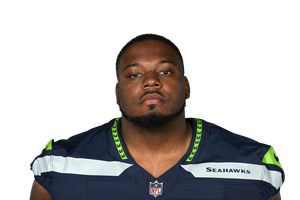
Michael
Jerrell.
 Findlay· 6'5"· 309 lb
"The only Division II player drafted in 2024, and by October he was starting at right tackle in an NFL stadium — the rare small-school swing that paid off inside six months."Pre-draft read
Findlay's blindside anchor for the back half of his career, Jerrell is a long, light-footed edge blocker whose game is built on range rather than mass. He fires out of his stance with a clean vertical set, wins depth quickly, and mirrors speed off the corner without leaning or opening his hips early. His hands are busy and he resets them well when the first strike misses.
In the run game he is best climbing to the second level and cutting off backside angles on wide zone, where his burst lets him reach spots most 309-pounders cannot. He is not a displacement mauler at the point; he wins by position and sustain, not knockback. The signature is body control in space — a D-II tackle who moved like a Power Five athlete.
Outside/wide zone running game paired with a quick-game passing attack that lets tackles use their feet instead of asking them to win in a phone booth.
Year 1: sixth or seventh offensive lineman and emergency tackle on both edges, with core special teams value in jumbo packages. Ceiling: a starting-caliber right tackle in a zone-heavy offense that protects him from isolated one-on-ones against elite power.
A gap/power scheme built on down blocks and duo, where tackles are asked to displace 320-pound ends at the point and hold up on long-developing seven-step drops with no chip help.
The move to Atlanta kept him in a zone-friendly environment, which matters: his athletic profile is the asset and a scheme that asks him to reach and climb is the only place it shows up.
Michael Jerrell Highlights | University of Findlay (DII)
Full college highlight reel: vertical sets, second-level climbs and the movement skills that carried him from D-II to the sixth round.
T Michael Jerrell Gets The Draft Call
Seattle's call to Jerrell with pick 207, the eighth and final selection of the Seahawks' 2024 class.
Findlay's Michael Jerrell picked in 6th round of NFL Draft
Local coverage of the only Division II player selected in the 2024 NFL Draft.
Jerrell arrived at Findlay as a 6-2 high school basketball body and left it as a 6-5, 309-pound tackle with 40 straight starts on his ledger. That development curve is the whole identity: a late-blooming, self-made lineman whose feet always graded above his frame, and who kept adding weight without losing the athleticism that made him worth watching in the first place.
The production case is games, not numbers. He appeared in 48 games across six years in Findlay's program and started 40 of them, closing his career with a 40-game consecutive start streak, and he stacked 2023 honors on top of it — All-G-MAC recognition and first-team Elite 100 All-America status from D2Football.com. The flag was obvious and unavoidable: the competition. G-MAC edge rushers do not simulate NFL speed-to-power, and every rep of good tape came with a caveat about who he was blocking.
So the board treated him as a projection, not a plug-in. He worked the Hula Bowl, tested well enough at Ohio State's pro day to move the needle, and took a top-30 visit with Indianapolis, with sixth-round grades attached. Seattle spent pick 207 — its eighth and final selection — on the only Division II player drafted in 2024. At that price the call is easy: buy the traits and let a developmental year settle the rest.
- 01
Vertical set and edge range
gets depth immediately out of his stance and mirrors speed rushers to the corner without ducking his head or overextending his outside arm.
- 02
Second-level mobility
climbs cleanly to linebackers and reaches backside defenders on wide zone, showing the short-area burst you rarely find at 309 pounds.
- 03
Hand resets
active, repeatable strikes with the ability to reload when the first punch misses, which kept him from getting stacked once rushers countered.
- 04
Availability and durability
48 career games with a 40-game consecutive start streak to close it out, a full body of work rather than a two-season sample.
- 05
Development curve
added roughly 60 pounds from high school without sacrificing his feet, and his last college season was clearly his best tape.
- 01
Level of competition
G-MAC edge rushers never tested him with NFL-caliber speed-to-power, so his anchor projection came almost entirely on faith.
- 02
Point-of-attack power
wins by position and sustain more than displacement, and he can get walked back when a heavy defender gets into his chest first.
- 03
Technique under duress
footwork and pad level tighten up against long-arm and inside-counter rushes, an issue that surfaced immediately at NFL speed.
- 04
Raw processing
stunt and twist recognition lagged, a predictable consequence of not seeing complex pressure packages at the Division II level.
| Yr | Team | G |
|---|---|---|
| 2018 | Findlay | — |
| 2019 | Findlay | — |
| 2020 | Findlay | — |
| 2021 | Findlay | — |
| 2022 | Findlay | — |
| 2023 | Findlay | — |
| Career | — | 48 |
Offensive linemen accumulate no box-score production, so only games and starts are tracked. Findlay is a Division II program and does not publish an OL games/starts table by season.
A dash means the figure is not published by a source we trust — never a zero we invented.
Honors
- D2Football.com Elite 100 first-team All-American (2023)
- All-G-MAC (2023)
- 40 consecutive starts to close his career
- Only Division II player drafted in 2024
Not the Hall of Fame arc, but the template of the profile: raw, athletic, non-blue-chip tackle who survives on movement skills while the anchor develops. Realistically a long-term swing tackle version of it.
The optimistic outcome: an oversized small-program athlete who grows into a multi-year zone-scheme starter at right tackle once the technique catches up to the feet.
The downside: an athletic tackle who never solves power or counters at the NFL level and settles into a roster-bubble backup role bouncing between teams.
Everything above is the pre-draft evaluation. This section is what actually happened — updated year over year.
Seattle did not redshirt him. Injuries along the tackle spots pushed Jerrell into the lineup in his rookie season, and he played 10 games with three starts at right tackle in 2024 — including an NFL debut as a starter, on the road, in Atlanta. The results were exactly what a D-II sixth-rounder in that spot should produce: flashes of the range and recovery athleticism that got him drafted, alongside clear losses to counters and power that he had never faced in the G-MAC. It was accelerated tuition, and it was still useful. In August 2025 Seattle traded him to Atlanta, where he slotted into the swing-tackle depth pool and appeared in two games, making his Falcons debut in Week 6. He entered 2026 on Atlanta's 90-man roster, still wearing 72, still competing for a job in the same offensive line room.
In hindsight the pick was fine and the ceiling was oversold the way these picks always are. Nobody spends 207 expecting a starter, and Seattle got three real starts and a tradeable asset out of it — a positive return on a sixth-round bet. What the tape has not delivered is the leap the traits implied: two years in, he is a backup whose best football still lives in the projection column rather than the résumé. The honest read now is a useful roster piece who has not yet forced anyone to make room for him.
Data note: Offensive linemen accumulate no box-score production, so only games and starts are tracked. Findlay is a Division II program and does not publish an OL games/starts table by season.