
Marvin
Harrison Jr..
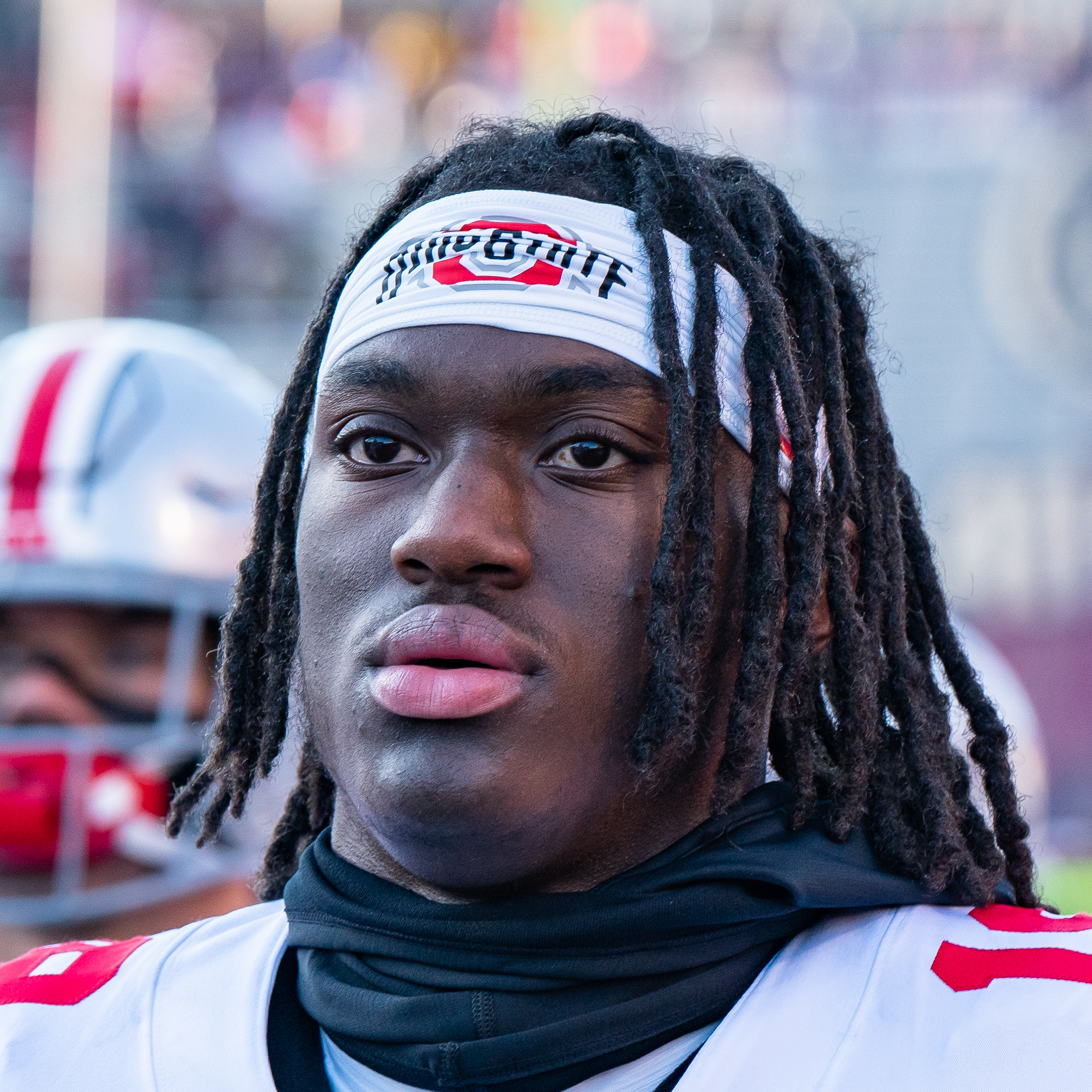
Marvin
Harrison Jr..
 Ohio State· 6'3"· 209 lb
"A route technician with a first-round pedigree and a No. 1 receiver's frame, Harrison arrived as the safest bet in the class and the rare college star whose separation came from craft rather than pure burst."Pre-draft read
Harrison was Ohio State's X receiver, a 6-3 boundary target who won the sideline third of the field with pace changes and footwork instead of raw twitch. He stemmed defenders off their leverage, sank his hips at the top of the stem and came out of breaks clean on comebacks, digs and slants, and he tracked the deep ball over either shoulder with rare body control.
The secondary trait was the catch radius and the strength through contact: he plucked away from his frame, worked back to the throw and finished through contested windows without losing the ball. He was a willing but unspectacular blocker in the run game, and the athletic ceiling projected as very good rather than elite, which made the technical polish the signature.
Timing-based play-action offense with a defined X on the boundary
Year 1: immediate outside starter and primary red-zone target on a full route tree. Ceiling: true No. 1 X who carries the passing game on volume outside the numbers.
A quick-game, RPO-heavy spread that lives on manufactured touches and yards after catch, where his separation on intermediate and deep routes is never asked for.
Value peaks with an accurate, rhythm passer who will throw him open on back-shoulder and comeback throws.
Marvin Harrison Jr. | 2023 Highlights
Final college season: route detail, deep tracking and contested finishes.
Marvin Harrison Jr. Highlights | Big Ten Film Session
Film-session breakdown of releases, stems and separation at the top of routes.
Heisman Finalist Marvin Harrison Jr. Highlights
Season-long reel showing red-zone wins and sideline ball adjustments.
Harrison entered the 2024 cycle as the most complete receiver prospect since Ja'Marr Chase: a big-bodied boundary starter with a full route tree, plus hands and a two-year record of production against the best coverage the Big Ten could offer. The football identity was never in question. He was a volume-tested X who could win outside the numbers on first down and inside the red zone on third.
The resume backed it. He caught 77 balls for 1,263 yards and 14 scores in 2022 and followed with 67 for 1,211 and 14 more in 2023 despite missing time and playing with unsettled quarterback play. Signature tape came against top corners, where he beat press with a stutter release and stacked immediately. The flags were narrow: he never tested, so the timed speed and explosion numbers were projections, and the play strength as a blocker and against physical press was more good than dominant.
The board consensus was a top-five lock and a plug-and-play WR1, with the only real debate being whether a quarterback or an edge should go first. Taking him fourth was the least controversial call in the round: a Cardinals offense with almost no perimeter threat added the highest-floor pass catcher available.
- 01
Route craft
Sold every stem the same way, changed pace at the top and came out of breaks with real separation on comebacks, digs and slants.
- 02
Hands and catch radius
Plucked away from his frame, adjusted late to off-target throws and finished contested balls without letting them into his chest.
- 03
Ball tracking
Located and adjusted over either shoulder on deep shots, with the timing and body control to win the sideline fade repeatedly.
- 04
Production against quality
Back-to-back 1,200-yard, 14-touchdown seasons against Big Ten starters, with his best tape coming against the best corners.
- 05
Red-zone value
Frame, timing and leverage control made him a reliable target inside the 10, where he won on boxing out and back-shoulder throws.
- 01
Untested athlete
He did not run or jump in the pre-draft process, so long speed and explosion had to be projected from tape alone.
- 02
Play strength vs press
Physical corners who got hands inside could delay releases and knock the timing off shorter routes.
- 03
Run blocking
Willing but inconsistent finishing on the perimeter, more of a screen shield than a defender remover.
- 04
Yards after catch
Not a creator in space; most of the damage came before the catch rather than from broken tackles.
| Yr | Team | G | Rec | Yds | TD |
|---|---|---|---|---|---|
| 2021 | Ohio State | 13 | 11 | 139 | 3 |
| 2022 | Ohio State | 13 | 77 | 1263 | 14 |
| 2023 | Ohio State | 12 | 67 | 1211 | 14 |
| Career | — | 38 | 155 | 2613 | 31 |
A dash means the figure is not published by a source we trust — never a zero we invented.
Big-bodied boundary receiver who wins on frame, tracking and red-zone leverage.
Volume X with elite hands and route detail rather than top-end speed.
Contested-catch outside receiver whose value swings hard with quarterback quality.
Everything above is the pre-draft evaluation. This section is what actually happened — updated year over year.
Arizona plugged him in as the immediate outside starter and he produced a solid but unspectacular rookie year: 62 catches for 885 yards and eight touchdowns, with clear chemistry issues on deep and back-shoulder throws and a handful of drops that became the storyline. Year two went the wrong direction. He finished 2025 with 41 receptions for 608 yards and four scores in 12 games as the offense collapsed around quarterback instability and the team lost its way down the stretch.
In hindsight the evaluation of the player still reads correctly, but the projection underrated how much of his game depends on quarterback timing. The routes, the hands and the red-zone value all showed up. What has not arrived is the volume and the explosive-play rate that a top-five receiver is drafted for, and two years of unstable throwing has made it hard to separate the player from the situation. The talent case remains open; the production case needs a stable quarterback to be settled.