Brandon
Dorlus.
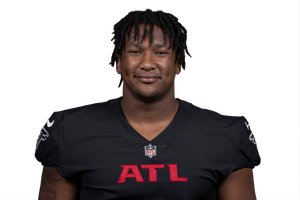
Brandon
Dorlus.
 Oregon· 6'3"· 283 lb· 4.85s 40
"Everyone spent the spring arguing about which position he was too small for, and Atlanta spent two years answering it with snaps: 8.5 sacks in Year 2 from a fourth-rounder no one could label."Pre-draft read
Dorlus played every front position Oregon had. He opened most downs as a base five-technique, then slid inside to a three-technique when the Ducks wanted their quickest interior body on the field. The get-off is the calling card: a real first-step advantage for a 283-pound lineman, converted into penetration with a long arm and a swipe-rip that beats a guard's outside hand before he can reset his feet.
Against the run he is a knifer rather than an anchor, and he wins by getting skinny into a gap instead of resetting the line of scrimmage. The separator is how his rush holds up when he is moved: he does not need a fixed alignment to be dangerous, and his best pass-rush reps came from a reduced spot with a runway and a two-way go.
Four-man, one-gap attacking fronts that let an interior lineman shoot a gap on the snap instead of reading and reacting.
Year 1: sub-package interior rusher on 15-20 snaps a game while the run defense catches up. Ceiling: full-time three-technique starter who plays 450-550 snaps and delivers eight-plus sacks from a reduced alignment.
A two-gap, 3-4 five-technique role that asks him to hold the point against doubles and control a tackle-tight end surface — at 283 pounds he gets displaced and his best trait, the get-off, never gets used.
He needs a coordinator willing to treat him as a rusher first and manage his early-down snaps against heavy personnel.
Brandon Dorlus | Defensive Line | Oregon | 2023 Highlights | 2024 NFL Draft
His senior tape: the season he led Oregon's line in sacks and passes defended and earned first-team All-Pac-12.
Oregon DT Brandon Dorlus Vs Washington: All Pass Rushes
Every pass rush against Washington — the cleanest look at the long-arm to swipe-rip from a reduced alignment.
Brandon Dorlus 2025 Highlights
The Year 2 breakout in Atlanta: 8.5 sacks as a starting interior rusher on a record-setting Falcons front.
He is a movement lineman in a run-defender's body — a five-year Oregon starter whose value was never tied to one alignment. The Ducks used him as a base end on first down, an interior rusher on third, and occasionally as a wide piece on the edge of their odd front. That flexibility, more than any dominant trait, is the profile.
Production followed the usage rather than exploding: 27 tackles for loss and 12 sacks across five seasons, with his best pass-rush year coming as a senior when he led Oregon's line in sacks and passes defended and earned first-team All-Pac-12. The flags were equally consistent. At 283 pounds he did not hold up as a true two-gapper, doubles moved him off his spot, and his hand plan lagged behind his athletic ability.
The board split him by role. PFF ranked him the fifth interior defender in the class and called the Falcons' pick one of the best values of Day 3; other rooms saw a tweener without a home who would be asked to play a position he was not built for. At 109 the argument was easy to make either way, because the athletic testing — including one of the fastest 40s any defensive lineman ran at the Combine — gave a defensive coordinator a reason to find him snaps while the technique caught up.
- 01
Explosive first step
his get-off is a genuine advantage inside, and he beats guards to the gap before they can set their base or pass off a stunt.
- 02
Alignment flexibility
five-technique, three-technique or wide edge, he has real reps at each and does not need a fixed spot to be useful to a front.
- 03
Long-arm to swipe-rip
his best pass-rush sequence pairs a stab that stalls the punch with a quick clear of the outside hand, and it works against both guards and tackles.
- 04
Rare movement skill for the weight
ran one of the fastest 40s of any defensive lineman at the 2024 Combine at 283 pounds, and it shows on stunts, loops and chase.
- 05
Backfield disruption
27 tackles for loss over five seasons, most of them earned by penetrating a gap rather than cleaning up plays that came to him.
- 01
Play strength versus doubles
at 283 pounds he gets displaced when two bodies find him, and he cannot hold a two-gap assignment for a full series.
- 02
Hand plan lags the athleticism
too many rushes end with him running an arc into contact instead of stacking a counter onto the initial move.
- 03
Anchor at the point
he wins by getting skinny rather than resetting the line of scrimmage, which limits him on early downs against a downhill run team.
- 04
Positional fit questions
too light for a true base end and not thick enough for a nose, so his value depends on a coordinator building a role around him.
— — — positional median (p50)
- 40 yd
- 4.85sp50
- Vertical
- 30.5inp50
- Broad jump
- 111inp50
- Three-cone
- 7.43sp50
- Shuttle
- 4.85sp50
- Bench
- —rep
| Yr | Team | G | Tkl | Sk | Int | PD | FF |
|---|---|---|---|---|---|---|---|
| 2019 | Oregon | 10 | 5 | 1 | 0 | 0 | 0 |
| 2020 | Oregon | 7 | 12 | 1 | 0 | 1 | 0 |
| 2021 | Oregon | 14 | 25 | 2.5 | 0 | 2 | 0 |
| 2022 | Oregon | 13 | 35 | 2.5 | 0 | 2 | 0 |
| 2023 | Oregon | 14 | 25 | 5 | 0 | 7 | 0 |
| Career | — | 58 | 102 | 12 | 0 | 12 | 0 |
A dash means the figure is not published by a source we trust — never a zero we invented.
The comparison his own position coach used — a big-bodied hybrid who breaks out in Year 2 as a 450-550 snap interior rusher with mid-single-digit sacks.
The ceiling if the hand plan keeps maturing: a full-time interior starter who wins with length and relentless rush volume from multiple alignments.
If the strength never catches the testing, an elite athlete who stays a situational rusher and never earns early-down snaps.
Everything above is the pre-draft evaluation. This section is what actually happened — updated year over year.
Atlanta redshirted him in practice. The rookie year was two games and three tackles, with almost no defensive role, which for a fourth-rounder on a defense that was still sorting its front was closer to a plan than a failure. Year two rewrote the profile. Dorlus started essentially every week in 2025, played 465 snaps, and turned 26 pressures into 8.5 sacks as part of a Falcons defense that set a franchise single-season sack record. A hamstring injury cost him the last stretch of the season — the initial fear was a knee, and the team's clarification was one of the better pieces of news it got in December. He came back for 2026 training camp on the active roster as a locked-in interior starter alongside Ruke Orhorhoro.
The hindsight verdict is that the tweener label was the wrong frame. The concern was never wrong about his anchor — he still is not the guy you leave on the field against a heavy run team on third-and-one — but Atlanta stopped treating that as a disqualifier and started treating it as a snap-count question. PFF called it one of the best values of Day 3 in April 2024 and looks correct in a way that most Day 3 calls do not: a 4-3 defense that lets him rush from a reduced alignment turned pick 109 into a starting pass rusher inside two years.