
Brandon
Coleman.
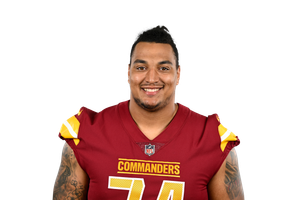
Brandon
Coleman.
 TCU· 6'5"· 313 lb· 4.99s 40
"The technique was always pro-ready; the anchor never quite caught up, and that gap is the difference between a starting left tackle and the best emergency lineman on the roster."Pre-draft read
Coleman is a 6-4, 313-pound left tackle whose game is built on length, patience and mirror discipline rather than violence. His pass set is unhurried and square, he punches on time, replaces his hands cleanly instead of grabbing, and he almost never lunges at the first move — the reason he finished his final TCU season charged with a single sack.
In the run game he is a positional blocker more than a mauler, at his best on down blocks and reach assignments where his frame and foot quickness let him wall defenders off rather than uproot them. The athleticism is real for the size, and the separating trait is recovery: beaten early in a rep, he re-anchors, resets his feet and still finds a way to finish the play standing.
Zone-heavy or gap/zone hybrid run game that lets him reach and wall rather than displace, paired with a rhythm passing game that keeps his sets short.
Year 1: sixth lineman and first tackle off the bench who can start a month of games at either edge. Ceiling: low-end starting left tackle in a zone scheme that protects him from isolated power rushers.
A drop-back, seven-step passing offense that asks him to hold up alone on long-developing sets against elite speed-to-power edges, or a duo/power run scheme built on vertical displacement.
Was tried at left guard in 2025 and the fit did not take; his value lives at tackle, where length and footwork matter more than raw pop.
Film Room: TCU Brandon Coleman Vs Baylor: All Pass Pro
Every pass-protection rep against Baylor — the clearest look at his set width and hand timing.
Brandon Coleman Left Tackle Highlights
TCU left tackle reel showing reach blocks, recovery balance and finish.
Brandon Coleman Highlights - Senior Bowl - OL TCU
Senior Bowl week reps against pro-caliber rushers, including the power tests that defined his flags.
A junior college transfer who grew into a three-year starter and a team captain, Coleman played every spot on the TCU offensive line before settling in at left tackle. The identity is a long, coordinated blocker with clean technique and unusual body control for a 313-pound frame, a player teams trusted to protect a blind side in a Big 12 that throws.
The production backs the tape. He started eight games in 2021, all 15 in 2022 on the run to the national championship game, and 11 more as a captain in 2023, when he was named second-team All-Big 12 and honorable mention conference lineman of the year while surrendering just one sack. The flags were about power, not process: he plays lighter than his listed weight at the point of attack, and speed-to-power rushers could walk him backward before he reset his base.
The board had him as a late Day 2 developmental tackle with a guard fallback, the type of evaluation that says the technique and length are pro-ready but the anchor needs an NFL weight room. Washington, coming off a season in which its line generated the most pressure allowed in football, took the swing at 67 and bet the frame would catch up to the footwork.
- 01
Pass-set mechanics
Square, patient sets with on-time hands and clean replacement; he wins by staying in front rather than by out-muscling the rush.
- 02
Length and frame
Long arms and a wide base let him control edges early in the rep and keep defenders from reaching his chest plate.
- 03
Recovery balance
When beaten off the snap he re-anchors and redirects instead of falling off the block, turning would-be losses into stalemates.
- 04
Positional versatility
Played every spot on the TCU line and was drafted with tackle-or-guard flexibility explicitly on the report.
- 05
Production and leadership
Team captain, second-team All-Big 12 and just one sack allowed as a senior across a full Big 12 slate.
- 01
Anchor against power
Speed-to-power bull rushers can walk him into the pocket before he sinks his hips and resets the base.
- 02
Play strength at the point
More of a positional run blocker than a displacer; he covers defenders up rather than moving them off the spot.
- 03
Late developmental arc
Junior college start plus an injury-shortened 2020 meant fewer reps than most three-year Power Five starters.
- 04
Grip retention
Loses late contact on longer reps when defenders convert to a second move, allowing separation at the finish.
Relative Athletic Score (Kent Lee Platte) benchmarks combine/pro-day numbers against every measured prospect at the position since 1987. 10.00 is elite; 5.00 is average.
— — — positional median (p50)
- 40 yd
- 4.99sp50
- Vertical
- 34inp50
- Broad jump
- 114inp50
- Three-cone
- —s
- Shuttle
- —s
- Bench
- —rep
| Yr | Team | G |
|---|---|---|
| 2020 | TCU | 4 |
| 2021 | TCU | 11 |
| 2022 | TCU | 15 |
| 2023 | TCU | 11 |
| Career | — | 41 |
TCU only (2020-2023); also appeared in seven games at Trinity Valley CC in 2019. Sacks-allowed figures are charting data, not official statistics.
A dash means the figure is not published by a source we trust — never a zero we invented.
Long, versatile swing lineman who starts stretches at multiple spots without locking one down.
Same technical, length-based pass-set profile if the anchor had grown into the frame.
Athletic tackle whose power deficit caps him as a spot starter and depth piece.
Everything above is the pre-draft evaluation. This section is what actually happened — updated year over year.
Washington threw him straight into the fire. Coleman started 12 of 16 games at left tackle as a rookie next to Jayden Daniels, and the results were what you would expect from a Day 2 pick asked to protect a franchise quarterback in year one: competent snaps against speed, exposed snaps against power, and enough functional football to survive a run to the NFC Championship game. When the front office responded by trading for Laremy Tunsil and drafting Josh Conerly Jr., his tackle job disappeared and he moved to left guard for 2025. He started the first two games there, was benched in Week 3 for Chris Paul, sat as a healthy inactive for five straight weeks, then re-emerged at tackle when Tunsil went down — playing well in relief against Kansas City and starting the final three games of the season on the edge.
In hindsight the pick looks like exactly what the profile said it was: a swing lineman, not a starter. The technique held up, the anchor never fully arrived, and the guard experiment did not stick. Two seasons in, 28 games and 17 starts, Coleman is a valuable emergency answer at tackle for a line that keeps needing one — real value at pick 67, just not the blindside solution Washington drafted him to be.
Data note: TCU only (2020-2023); also appeared in seven games at Trinity Valley CC in 2019. Sacks-allowed figures are charting data, not official statistics.