
Zach
Harrison.
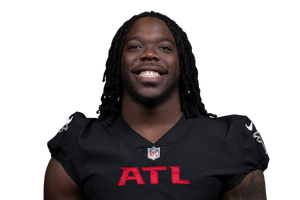
Zach
Harrison.
 Ohio State· 6'6"· 274 lb
"A five-star body and a role player's resume, and Atlanta paid the role player's price for it — the longest arms measured at the Combine in a decade attached to a rush plan that never fully arrived."Pre-draft read
Harrison played base end in Ohio State's four-man front, a 6-foot-6, 272-pound edge who set up wide on early downs and reduced inside on passing situations. His calling card was length: with 36-plus-inch arms he stacked, extended and shed as cleanly as any Buckeye of his era, keeping blockers off his frame. The mechanics were built on strike timing, not ankle bend.
The secondary trait was power on the move, a long-arm and bull that walked tackles into the pocket when he timed the snap. Against the run he was a genuine plus, squeezing the C-gap and refusing to be reached. Rushing the passer he converted more than he created. The signature: rare tools bolted onto a workmanlike base-end game.
Even four-man front that values edge setting on early downs and can hide the pass-rush limitation with stunts and reduced alignments on third down.
Year 1: early-down base end in a four-man rotation, roughly 350-450 snaps, taken off the field on obvious passing situations. Ceiling: full-time base end who plays 600 snaps, controls the run and adds five to seven sacks as a converter.
A 3-4 outside linebacker role that asks him to drop into coverage or win the edge from a two-point stance in space — his hips and change of direction are not built for it, and his value is in a hand-in-the-dirt strike-and-shed rep.
His pass-rush value is highest as an inside reducer on stunts, where his length beats a guard's punch before the guard can get square.
Zach Harrison Ohio State DE Highlights
Career reel showing the length, the long-arm and the edge-setting reps that defined his Ohio State tape.
Zach Harrison 2021 Highlights
Junior-season cutup: strike-and-shed work against Big Ten tackles and the power rush inside.
Zach Harrison highlights | 2023 NFL Draft
Official Falcons draft reel released after Atlanta took him 75th overall.
Harrison arrived in Columbus as a five-star, top-five national recruit and the No. 1 defensive end in his class, and left four years later as something narrower and more useful: a long, dependable edge setter who did the unglamorous half of the job well. He is a hand-fighter, not a bender, and evaluators had to decide whether the traits still hid a pass-rush plan.
The production never matched the recruiting profile. Across 42 games he totaled 105 tackles, 25.0 tackles for loss and 12.0 sacks, with a career best of 34 tackles, 8.0 TFL, 3.5 sacks and three forced fumbles as a 2022 senior. He was steady rather than disruptive, and Ohio State's rotation and coverage-heavy structure did him no favors. The Combine reframed the conversation: 36 1/4-inch arms, the longest of any defensive lineman measured since 2014, 34.5-inch vertical, 10-3 broad and 25 bench reps at 274 pounds.
Boards had him mostly in the third-to-fourth-round band, a developmental big end whose floor was a rotational run defender and whose ceiling depended on a coach willing to teach him a rush plan. At 75 overall Atlanta bought exactly that: a scheme-proof body for Ryan Nielsen's front, cheap enough that the pass-rush projection did not have to hit for the pick to work.
- 01
Length that shows up
36 1/4-inch arms, the longest of any defensive lineman at the Combine since 2014, and he plays through them with real extension instead of letting blockers into his chest.
- 02
Edge integrity
sets a hard edge against down blocks and pullers, squeezes the C-gap and does not get reached, which is why Ohio State left him on the field on early downs.
- 03
Power on contact
a long-arm and bull that walks tackles into the pocket when he times the snap, and heavy enough hands to jolt a set before it establishes depth.
- 04
Positional versatility
comfortable reducing inside to the B-gap on passing downs at 274 pounds, giving a front two alignments out of one body type.
- 05
Effort and finish
three forced fumbles as a senior came from late pursuit and chasing plays down from the back side, not from clean one-on-one rush wins.
- 01
No rush plan
wins came from power and effort rather than a sequenced counter package, and he had no reliable second move when the long-arm stalled.
- 02
Get-off
average first-step quickness for a player this long, so he rarely threatened tackles vertically or won at the top of the arc.
- 03
Pad level
plays tall out of a 6-foot-6 frame and can be run at by leverage blockers who get under his hands early in the rep.
- 04
Production gap
12.0 career sacks in four seasons for a five-star at a program with elite talent around him, a modest return that a team had to bet against.
— — — positional median (p50)
- 40 yd
- —s
- Vertical
- 34.5inp50
- Broad jump
- 123inp50
- Three-cone
- 7.33sp50
- Shuttle
- 4.66sp50
- Bench
- 25repp50
| Yr | Team | G | Tkl | Sk | Int | PD | FF |
|---|---|---|---|---|---|---|---|
| 2019 | Ohio State | 10 | 24 | 3.5 | 0 | 0 | 0 |
| 2020 | Ohio State | 7 | 14 | 2 | 0 | 2 | 0 |
| 2021 | Ohio State | 12 | 33 | 3 | 0 | 4 | 2 |
| 2022 | Ohio State | 13 | 34 | 3.5 | 1 | 4 | 3 |
| Career | — | 42 | 105 | 12 | 1 | 10 | 0 |
2020-2022 verified season-by-season on cfbstats (bowl and CFP games included). cfbstats has no 2019 archive for this player, so the freshman line (10 G, 24 tackles, 5.5 TFL, 3.5 sacks) comes from the CFBD season ledger; career totals are the sum of the four listed seasons and reconcile with the public career marks of 25.0 TFL, 12.0 sacks and 10 pass breakups. Forced-fumble and fumble-recovery career totals are left blank because the 2019 splits are not verifiable.
A dash means the figure is not published by a source we trust — never a zero we invented.
A rotational run-first lineman who plays 400-500 snaps a year, holds the point and produces two to four sacks off effort.
Same big-bodied base-end archetype who found a rotational NFL role on length and power without ever becoming a primary rusher.
A long, powerful edge whose lack of a rush plan and get-off capped him as a situational early-down body who never cleared the rotation.
Everything above is the pre-draft evaluation. This section is what actually happened — updated year over year.
Zach Harrison played his rookie season with the Atlanta Falcons, appearing in all 17 games as a defensive end.
Atlanta drafted him as a body for the base defense and used him that way. He played all 16 games as a rookie in 2023 and posted 33 tackles and 3.0 sacks, respectable snap-for-snap work for a third-rounder in a rotation. Year 2 was flatter: 17 games, 26 tackles and just 1.0 sack in 2024, with his value living almost entirely on early downs while Atlanta's pass rush stayed a leaguewide punchline. The breakthrough came in 2025. Through seven games he had 22 tackles, 4.5 sacks and two forced fumbles, on pace for the best season of his career, before a knee injury suffered in the Week 7 loss to San Francisco put him on injured reserve in late November and eventually ended his year. He came back to make Atlanta's initial 53-man roster in 2026 on the last season of his rookie deal.
In hindsight, this is close to what a third-round edge is supposed to be. The pick was never going to return a double-digit sack season, and it hasn't. What it has returned is a durable, scheme-proof rotational lineman who holds the edge, takes 400-plus snaps a year and cost almost nothing. The 2025 half-season is the honest teaser: the rush juice finally showed up in his third year, and the knee took it away before anyone could decide whether it was real. He remains an unfinished evaluation rather than a settled one, and 2026 is the year that answers it.
Data note: 2020-2022 verified season-by-season on cfbstats (bowl and CFP games included). cfbstats has no 2019 archive for this player, so the freshman line (10 G, 24 tackles, 5.5 TFL, 3.5 sacks) comes from the CFBD season ledger; career totals are the sum of the four listed seasons and reconcile with the public career marks of 25.0 TFL, 12.0 sacks and 10 pass breakups. Forced-fumble and fumble-recovery career totals are left blank because the 2019 splits are not verifiable.