
Jonathan
Mingo.
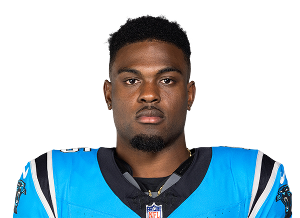
Jonathan
Mingo.
 Ole Miss· 6'2"· 220 lb· 4.46s 40
"Carolina paid a starter's price for a one-year producer whose tape promised mass and straight lines, then asked him to win the routes his college offense never made him run."Pre-draft read
Big-slot and boundary Z who wins with mass and contact balance rather than separation quickness. Ole Miss used him as the physical answer in a tempo spread: bubble screens, glance concepts and slot fades that let him get downhill with a head of steam. He builds speed in a straight line and finishes through contact at the catch point with strong, late hands.
The secondary trait is run-game utility — he blocks with intent from the slot and will dig out a safety on perimeter zone, which kept him on the field on early downs. As a route runner he is a builder, better on slants, posts and digs than on anything demanding a sudden stop. The signature is yards after catch through arm tackles: he plays like a big back once the ball is in his hands.
Play-action heavy offense with a manufactured-touch package that gets him the ball at speed instead of asking him to separate.
Year 1: WR3 who blocks on early downs and takes designed touches. Ceiling: physical WR2 in a play-action offense.
A timing-and-spacing passing game that lives on option routes and asks the slot to win one-on-one against nickel press.
The scheme has to create his leverage; he does not manufacture it himself.
Jonathan Mingo 2022 Highlights | Ole Miss WR | 2023 NFL Draft Prospect
Senior-season cutups: slot fades, glance routes and yards after contact.
Jonathan Mingo 2022 Ole Miss Highlights
Full 2022 reel including the 247-yard game against Vanderbilt.
Jonathan Mingo Ole Miss WR Highlights || Physical Playmaker
Contact-balance compilation and perimeter blocking reps.
Physical, high-cut receiver with an NFL frame and a fifth-year breakout, evaluated as a big-slot who could grow into a starting X in a scheme that manufactures touches. The football identity is contact: at the catch point, after the catch, and as a blocker. Nothing about the profile is finesse.
Production tells the story of a slow build. Twelve catches as a freshman, 27 in an injury-shortened sophomore year, then six games in 2021 before a foot injury ended it. The senior season was the evidence: 51 catches for 861 yards and five scores at nearly 17 yards a grab, including a 247-yard afternoon against Vanderbilt that put him on every board. The flags were the ones that always come with a one-year profile — a route tree that lived on verticals and slants, hands that fought the ball on off-target throws, and separation numbers that never matched the athletic testing.
Consensus had him as a late-first to early-second option with a wide range: teams that valued the frame, testing and blocking took him higher; teams that wanted a refined route runner had him in the third. Carolina, in the same draft they moved up for a quarterback, spent the 39th pick on the receiver they believed would be that quarterback's physical target. It was a bet on traits over separation.
- 01
Contact balance
plays like a running back after the catch, running through arm tackles and finishing runs forward instead of looking for the sideline.
- 02
Catch-point strength
attacks the ball with late, strong hands and can win contested throws on slot fades and back-shoulder verticals.
- 03
Deep-ball tracking
adjusts smoothly over either shoulder on the go route and rarely lets the ball get into his frame downfield.
- 04
Perimeter blocking
willing and effective as a run-game blocker from the slot, sustaining on safeties and nickels on outside zone.
- 05
Frame and testing profile
6-2, 220 with legitimate straight-line speed for the size, an unusual combination in the 2023 receiver class.
- 01
Separation quickness
high-cut and stiff in the hips, which shows up as tight breaks and late windows against press-man coverage.
- 02
Route tree
Ole Miss asked mostly for verticals, slants and manufactured touches, leaving the intermediate menu underdeveloped.
- 03
Hands consistency
will fight the ball on off-target throws and had drops on routine targets when he took his eyes downfield early.
- 04
One-year production
a single season above 400 receiving yards makes the projection lean heavily on traits rather than a track record.
— — — positional median (p50)
- 40 yd
- 4.46sp50
- Vertical
- 39.5inp50
- Broad jump
- 129inp50
- Three-cone
- —s
- Shuttle
- —s
- Bench
- 22repp50
| Yr | Team | G | Rec | Yds | TD |
|---|---|---|---|---|---|
| 2019 | Ole Miss | — | 12 | 172 | 1 |
| 2020 | Ole Miss | 10 | 27 | 379 | 3 |
| 2021 | Ole Miss | 6 | 22 | 346 | 3 |
| 2022 | Ole Miss | 13 | 51 | 861 | 5 |
| Career | — | 29 | 112 | 1758 | 12 |
Season lines verified on cfbstats (2020-2022) and the 2019 freshman receiving line via ESPN; cfbstats has no 2019 page for him, so freshman games played is left unverified rather than zero-filled. Career totals (112 rec / 1,758 yds / 12 TD) match the sum of the four seasons. The 2021 season ended after six games with a foot injury.
A dash means the figure is not published by a source we trust — never a zero we invented.
Same size-speed profile and same problem — traits that test well but never turned into consistent separation at the NFL level.
The realistic ceiling if the route tree expands: a big-bodied possession starter who wins the catch point and moves the chains.
The floor for a high-pick physical receiver without a route tree: a blocker and depth body who never finds a steady offensive role.
Everything above is the pre-draft evaluation. This section is what actually happened — updated year over year.
Mingo played in 15 games for the Carolina Panthers in his rookie season, starting 11. He recorded 23 receptions for 418 yards, but did not score a touchdown.
Carolina played him immediately, and the fit problem showed immediately. He started 12 games as a rookie in an offense with a rookie quarterback and almost no route structure, finishing 43 catches for 418 yards on 85 targets — no touchdowns, 9.7 yards a catch, one of the worst efficiency lines a second-round receiver has posted in years. The 2024 season went worse: nine games, 12 catches, then a November trade to Dallas for a fourth-round pick. Dallas gave him eight games and five catches. In 2025 he sat behind CeeDee Lamb, played six games with a single 25-yard reception, and landed on injured reserve with a PCL injury. He enters 2026 on a roster bubble with zero career touchdowns.
In hindsight the evaluation was right and the price was wrong. The tape said big body, straight lines, tough after the catch; the separation profile said role player. Carolina paid starter money in draft capital for the traits and then asked him to win routes in an offense that could not scheme him free — the exact environment the profile warned against. Yards-after-catch mass without a route tree needs a functioning play-caller and a defined manufactured-touch role, and he never got either. Two rounds later, this is a useful WR3 and core blocker instead of a cautionary tale.
Data note: Season lines verified on cfbstats (2020-2022) and the 2019 freshman receiving line via ESPN; cfbstats has no 2019 page for him, so freshman games played is left unverified rather than zero-filled. Career totals (112 rec / 1,758 yds / 12 TD) match the sum of the four seasons. The 2021 season ended after six games with a foot injury.