Joe
Tippmann.
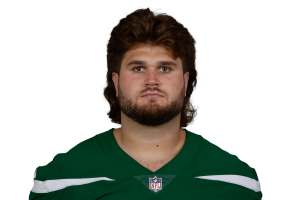
Joe
Tippmann.
 Wisconsin· 6'6"· 313 lb
"The tallest center in the class, and the only one who could reach a backside three-technique and still land a moving block on a linebacker ten yards downfield on the very same drive."Pre-draft read
A four-year Badger who redshirted, waited, then owned the pivot for two full seasons, Tippmann is a 6-6, 313-pound center whose game starts with reach and range. He is the rare snapper who can zone-step, climb and cut off a backside three-technique on wide zone, and Wisconsin leaned on that mobility to get him on linebackers in space.
The secondary trait is grip strength once he lands. In the run game he sustains and steers; in protection he is a calm communicator who resets his hands and rarely loses the same rush twice. The athletic ceiling is scheme-proof — he can pull, fold and block on the move — and the signature is simple: a center built like a tackle who still moves like a guard.
Outside and wide zone running game paired with a quick, rhythm-based passing attack that asks the center to reach, climb and make the calls.
Year 1: plug-and-play interior starter who can open at guard while learning the pivot. Ceiling: decade-long starting center who sets every protection.
A heavy gap-and-power offense that lines him up over a two-gapping 340-pound nose on duo and asks him to win by displacement on a static base block.
His length is an asset in space and a liability in a phone booth, so the scheme has to let him move rather than absorb.
Wisconsin OL Joe Tippmann Film Breakdown
All-22 look at the reach blocks and second-level climbs that made him the class's most athletic center.
Joe Tippmann: NFL Draft's Best Center? All-22 CFB Analysis
Pre-draft evaluation weighing his range and grip strength against the pad-level and anchor concerns.
Joe Tippmann: The Next Great Jets Center | 63-Play Film Breakdown
Rookie-season Jets tape breaking down every snap of his transition to the NFL pivot.
Tippmann was the tallest starting center in the class and the argument for him was that the height was a weapon rather than a tax. He is a former four-star tackle recruit out of Fort Wayne who moved inside at Wisconsin, and the position change gave him the footwork and the frame of a player who could have stayed outside.
He redshirted in 2019, appeared sparingly in the shortened 2020 season, then started two full years in one of the most demanding run schemes in the Big Ten. That context matters: Wisconsin asked its center to identify fronts, reach nose tackles and climb to second-level backers on counter and wide zone, and Tippmann handled all of it well enough to earn honorable-mention All-Big Ten in 2022 before skipping the bowl game to declare. The flag was leverage. At his height his pad level rises under bull rushes, and quick, low interior rushers could get under his chest before his hands arrived.
The board treated him as a clean top-100 name, with Dane Brugler inside his top 100 and mock consensus firmly in round two. He skipped Combine testing, so the athletic case rested on tape. New York taking him 43rd was less a reach than a plan: a young quarterback room needed a center who could set protections for a decade, and the Jets bought the floor rather than the flash.
- 01
Reach and range
a 6-6 frame with tackle-caliber foot quickness that lets him cut off backside defenders on wide zone and still climb to the second level.
- 02
Second-level blocking
genuinely dangerous in space, tracking linebackers on counter and screens with the balance to land moving strikes instead of lunging.
- 03
Grip and sustain
once his hands fit inside the breastplate he steers and finishes, turning small displacement wins into running lanes that stay open late.
- 04
Football intelligence
clean front identification and protection calls in a pro-style Big Ten scheme, with the communication traits teams want in a long-term pivot.
- 05
Positional flexibility
the recruiting background at tackle and the length to slide to guard give him legitimate value at all three interior spots.
- 01
Pad level
height works against him when he plays tall, and power rushers can get under his chest and walk him into the pocket before he resets.
- 02
Anchor versus bull
his base narrows against heavy nose tackles, and he gives ground on first contact more often than his strength grade suggests he should.
- 03
Hand timing
strikes can arrive late or land outside the frame, which lets quick interior rushers swipe through and cross his face on passing downs.
- 04
No testing profile
he skipped drills at the Combine, so the athletic projection rests entirely on tape with no verified numbers to confirm it.
| Yr | Team | G |
|---|---|---|
| 2019 | Wisconsin | 0 |
| 2020 | Wisconsin | 2 |
| 2021 | Wisconsin | 12 |
| 2022 | Wisconsin | 11 |
| Career | — | 25 |
Offensive linemen accumulate no box-score statistics. Games played by season verified against public draft-database game logs and sum exactly to the 25-game career total; 2019 was a redshirt year with no game action. Start totals are not published season by season, so they are left blank rather than estimated -- contemporaneous reporting describes him as a two-year starter at center (2021-2022).
A dash means the figure is not published by a source we trust — never a zero we invented.
Honors
- Honorable mention All-Big Ten (2022)
- Rimington Trophy watch list (2022)
- Two-year starting center at Wisconsin (2021-2022)
A long-tenured zone-scheme starter whose movement skills carry him even when the anchor gets tested.
The upside case: an athletic, high-IQ pivot who becomes the identity of an offensive line and earns All-Pro consideration.
A serviceable starter who never wins the leverage battle consistently enough to become a strength up front.
Everything above is the pre-draft evaluation. This section is what actually happened — updated year over year.
A durable, versatile interior starter who has never missed a start since taking over the job, and who proved his positional flexibility by moving from center to right guard without a drop in play.
The Jets got a starter immediately. Tippmann started 14 games as a rookie in 2023, roughly ten at center and four at guard, learning the job in a chaotic offensive line room while a quad injury cost him a midseason game. In 2024 he was handed the pivot outright and never gave it back, playing all 17 games as the full-time center and settling into the role the pick was made for. Then 2025 rewrote the plan: when Alijah Vera-Tucker went down with a season-ending injury before Week 1, New York slid Tippmann to right guard, and he played 17 games there, finishing with a 66.0 PFF grade that ranked 33rd of 81 qualifying guards on 1,045 snaps. In June 2026 the Jets signed him to a four-year extension reported around $62 million, and he entered the 2026 season with streaks of 44 consecutive starts and games played.
In hindsight this is what a second-round offensive lineman is supposed to look like. He was not a Pro Bowler and the leverage concerns scouts flagged never fully disappeared — he still plays a touch tall against heavy interior power — but he became the thing New York drafted him to be: durable, smart, positionally flexible and paid. That he was good enough to move off his natural spot and still hold up at guard is the whole scouting report validated. Solid hit.
Data note: Offensive linemen accumulate no box-score statistics. Games played by season verified against public draft-database game logs and sum exactly to the 25-game career total; 2019 was a redshirt year with no game action. Start totals are not published season by season, so they are left blank rather than estimated -- contemporaneous reporting describes him as a two-year starter at center (2021-2022).