
Wyatt
Hubert.
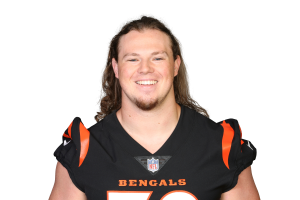
Wyatt
Hubert.
 Kansas St.· 6'2"· 258 lb· 4.93s 40
"A 6'2", 258-lb Kansas State edge with 20 career sacks and 36.5 tackles-for-loss on short 31-inch arms and a 7.29 RAS — a Round-7 rotational strong-side end whose motor was the argument, not the length."Pre-draft read
A compact, high-motor strong-side end; he wins with leverage, hand activity, and relentlessness, not elite bend or length. Primarily a 5-technique or wide-9 in even fronts, his frame and play strength allow him to reduce inside on passing downs. As a rusher, his violent long-arm punch-and-swipe pairing stuns tackles, creating a two-way decision; his average get-off means wins come from setting a hard edge, converting speed to power, and finishing pocket collapses.
His hands are consistently active, shedding on contact, but his counter package is thin; rips and spins are late-developed answers. Against the run, he excels: eyes track the guard-tackle key, his nearside arm locks out, and he can spill or squeeze according to scheme. His finish rate and willingness to chase from the backside are true separators.
A four-man defensive line that employs a one-gap 4-3 penetrating front with wide-9 or 5-technique defensive ends attacking upfield.
As an undersized 5-technique he can develop into a rotational run-downs specialist capable of setting the edge and spilling runs, with an upside as a bull-rush pass-rusher on passing downs.
He would be a poor scheme fit for a two-gap 3-4 defense that relies on length and mass at the strong-side end position to eat up blocks.
Hubert's strength, motor, and hand usage make him a valuable asset in a penetrating front, with his defined run-stopping ability providing a clear path to early playing time.
Kansas State defensive end Wyatt Hubert
Game film cut-up of Wyatt Hubert's Kansas St. tape.
Kansas State Defensive End Wyatt Hubert's first two years
Game film cut-up of Wyatt Hubert's Kansas St. tape.
Wyatt Hubert Highlights ll"John Wayne"ll
Game film cut-up of Wyatt Hubert's Kansas St. tape.
A three-year starter and two-time captain, he projects as a rotational strong-side end for a team seeking a high-motor player with reliable run defense and an effort-based pass rush. His production against Power Five competition, coupled with his physical play and leadership, makes him a valuable depth piece for a defensive line, especially for a team that values his 7.29 RAS.
He was a 30-game starter at Kansas State, where he transitioned from a three-star recruit to a key defensive player. His All-Big 12 first-team selection in 2019, marked by 14.5 tackles-for-loss and 8.5 sacks, highlighted his ability to disrupt offenses. Despite a shoulder issue impacting a shortened 2020 senior season, his consistent usage across different schemes underscored his reliability.
Evaluators noted his production and motor were significant assets, but concerns existed regarding his 31-inch arm length and limited bend, which could hinder his effectiveness against longer NFL tackles. Consensus placed him in the late-Day-3 or priority free agent tier, and he was ultimately selected by the Cincinnati Bengals in the seventh round.
- 01
Three-year production floor
A 30-game starter in the Big 12 with 20 sacks and 36.5 tackles-for-loss, headlined by an All-Big 12 first-team 2019 with 8.5 sacks and 14.5 TFL against Power Five tackles on tape.
- 02
Long-arm to club
His signature pass-rush move: a compact long-arm that gets extension into the tackle's chest, followed by a violent club-swim that has real finishing juice when the pocket bows and the quarterback has to climb.
- 03
Edge-setting play strength
Reduces inside as a 5-technique and holds ground versus down blocks and pullers, with the near-arm lockout and hip discipline to squeeze the C-gap and force cutbacks into the linebacker level.
- 04
Motor and pursuit finish
Chases plays flat down the line and finishes from the back side; the tape is full of eight-to-fifteen-yard sacks and TFLs that come from refusing to be blocked after the play breaks scheme.
- 05
Captaincy and football character
Two-time team captain at Kansas State who was the defensive alpha under Chris Klieman, praised in interviews and pre-draft calls for practice habits, film prep, and locker-room standing.
- 01
Short-armed for the position
31-inch arms is below the ideal edge threshold and shows up on tape: NFL tackles with 34-plus-inch reach can stab first, control the frame, and steer him past the top of the pocket before the counter starts.
- 02
Average get-off
First-step quickness is functional rather than sudden, so he does not win the corner with pure speed; the wins have to be earned with power, hands, and effort, which is a slower path to production.
- 03
Tight hips and limited bend
Struggles to lean under and flatten the arc as a speed rusher, which turns some potential edge wins into pressures instead of sacks and gives quarterbacks a lane to climb.
- 04
Thin counter package
The rip, the spin, and the inside cross-chop are late-developed answers rather than primary weapons, so when the long-arm is neutralized, the second move is often just re-engaging.
Relative Athletic Score (Kent Lee Platte) benchmarks combine/pro-day numbers against every measured prospect at the position since 1987. 10.00 is elite; 5.00 is average.
— — — positional median (p50)
- 40 yd
- 4.93sp50
- Vertical
- 32.5inp50
- Broad jump
- 110inp50
- Three-cone
- 7.03sp50
- Shuttle
- 4.28sp50
- Bench
- —rep
| Yr | Team | G | Tkl | Sk | Int | PD | FF |
|---|---|---|---|---|---|---|---|
| 2018 | Kansas State | 12 | 34 | 4.5 | 1 | 1 | 0 |
| 2019 | Kansas State | 13 | 33 | 7 | 0 | 0 | 0 |
| 2020 | Kansas State | 10 | 27 | 8.5 | 0 | 1 | 0 |
| Career | — | 35 | 94 | 20 | 1 | 2 | 0 |
A dash means the figure is not published by a source we trust — never a zero we invented.
Likely outcome: undersized-armed strong-side end who earns a 53-man spot on effort, run-defense, and core teams while chasing rotational rush snaps.
High comp reflects the compact strong-side archetype with a signature long-arm and steady sack production, but Kerrigan cleared the 34-inch-arm bar Hubert did not.
Low-end path: a rotational base end who bounces between practice squad and active roster and lives on situational run-down work.
Everything above is the pre-draft evaluation. This section is what actually happened — updated year over year.
Pre-draft context. Wyatt Hubert arrived at Kansas State as a Topeka-area three-star, redshirted in 2017, and started 30 games across three seasons as the defensive alpha of a rebuilt Chris Klieman program. His 2019 breakout — 14.5 tackles-for-loss and 8.5 sacks — earned first-team All-Big 12 and elevated him from priority-free-agent chatter into the Day-3 conversation. A shortened, shoulder-affected 2020 senior year (7 TFL, 4 sacks in eight games) cooled the buzz, and his pro-day workout confirmed the profile scouts already saw on tape: a 6'2", 258-pound edge with 31-inch arms, a 4.93 forty, a 7.03 three-cone, and a 7.29 RAS. Boards had him as a late-Round-7 to priority-UDFA strong-side end whose motor and captaincy were the sell and whose length and bend were the flags.
NFL fit — Cincinnati Bengals. Cincinnati took Hubert with pick 235 as a developmental depth end behind Trey Hendrickson and Sam Hubbard, exactly the archetype for the defensive approach that unit favored to spell the starters on run downs. He spent his rookie year on the practice squad, was elevated for a single regular-season game, and was on the practice-squad path during the Bengals' Super Bowl LVI run. He bounced between the practice squad and the fringe of the 53 into 2022 and 2023 before being waived and cycling through short auditions elsewhere. The NFL role never expanded beyond emergency depth and special-teams looks; the length and get-off that flagged pre-draft capped the ceiling exactly where scouts said they would.
Retrospective. A textbook Round-7 outcome: a captain and a producer whose motor earned him NFL paychecks and a Super Bowl locker-room spot, but whose physical thresholds kept the role at the practice-squad and gameday-inactive margin. The Bengals got what late seventh-round edges are supposed to give a contender — a professional who competed for a job, held up in camp reps, and did not cost anything if it did not hit. The pick was priced correctly; it simply did not clear the length-and-bend bar the NFL demands to become more.