
Tyler
Shelvin.
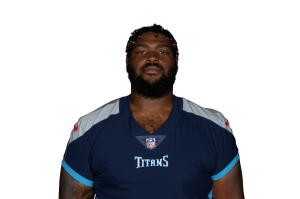
Tyler
Shelvin.
 LSU· 6'2"· 350 lb· 5.40s 40
"A 6'2", 346-pound LSU nose tackle whose 2019 title-run reps were the argument, then a 2020 opt-out and a 1.48 RAS — a Round-4 two-down bet on anchor and short-area power with almost no rush profile."Pre-draft read
Plays as a true two-gap nose tackle, eating blocks between the A-gaps to free linebackers. His wide, sunk base and heavy hands stack centers on contact, locking out double teams before flowing laterally. Pad level varies; when low, he anchors and pushes the pocket vertically, but when upright, centers wash him off the ball.
Hand usage is functional yet limited, featuring a serviceable long-arm and a shoulder-dip swim on light snaps. He lacks a counter or cross-chop. Foot quickness off the snap is average, and pursuit stops at the tackle box. As a pass rusher, he is a pure push-the-pocket player, using a bull rush to collapse the middle without generating sacks. Conditioning issues surface on third-and-long, impacting his anchor.
This prospect best fits a one-gap 4-3 penetrating front or 3-4 two-gap scheme where his size can clog interior gaps on run downs.
Year 1 role as a rotational run-stuffing 1-tech/0-tech in sub-packages, with a ceiling as an every-down two-gap nose in an even front.
Spread RPO or other up-tempo schemes that require quick reaction and pursuit outside the hashes.
Shelvin is a true run-clogger whose value lies in eating blocks to free up linebackers, but his limited pass-rush and athletic profile pigeonhole him into a specific scheme and role.
Tyler Shelvin — LSU Junior Year Highlights (2019)
Championship-season nose tackle reel: double-team draws, A-gap anchor, and the 2019 SEC/Bama tape that formed the draft file.
Burrow & Shelvin — From LSU to AFC Championship
ESPN short tracing the LSU-to-Cincinnati connection through the Bengals' Super Bowl LVI run.
Draft Day: LSU Nose Tackle Tyler Shelvin
Local Louisiana coverage of Shelvin's Round 4 selection by the Bengals.
Shelvin projects as a base-down, two-gap plugger, ideally suited for roles demanding a disruptive presence against the run in the interior. His value stems from his ability to stalemate blockers and free up linebackers, a necessary component for defenses built on controlling the line of scrimmage. The 1.48 RAS underscores the narrowness of this role.
He played 39 games at LSU across three seasons as a run-clogging one-tech, notably contributing to the 2019 national championship defense alongside Rashard Lawrence. Shelvin opted out of the 2020 season, meaning all evaluations relied on his 2019 film. He consistently faced elite SEC competition and was an integral part of a successful defensive unit.
The primary concerns for evaluators were his athletic testing, specifically his 5.40 forty and lack of a pass-rush plan, coupled with conditioning questions that dated back to his high school days. Consensus boards placed him as a mid-Day 3 pick, acknowledging his specific but limited role. He was ultimately drafted in the fourth round, 122nd overall.
- 01
Nose-tackle anchor
346-pound base with a natural sink lets him stalemate centers one-on-one and split double teams on run downs, the exact trait LSU rode in the 2019 title run behind Chaisson and Lawrence.
- 02
Two-gap length and stack
Long arms and heavy hands lock out on the center's chest, keeping his frame clean so linebackers can scrape over the top; classic block-eater profile that translates against gap and duo schemes.
- 03
Championship-defense pedigree
Rotational contributor on the 2019 LSU defense that carried Burrow's offense to a national title, three-year SEC starter against Alabama, Georgia and Auburn interior lines.
- 04
Short-area pop as a bull
When pad level is right he generates violent initial displacement, walking single blockers into the quarterback's lap and giving edges room to work off his rush lane on stunts.
- 05
Positional value in even fronts
Fits a specific archetype (base-down 1-tech in 4-3 under or 3-4 nose looks) that every defense still needs on early downs, giving him a clear projection despite athletic testing concerns.
- 01
Bottom-of-class athletic testing
1.48 RAS with a 5.40 forty, 28.5-inch vertical, 97-inch broad and 8.15 three-cone; every explosive and change-of-direction number sits in the sub-15th percentile for defensive tackles.
- 02
No pass-rush plan
College tape shows one move (bull) and no counter; a good center resets his hands and the rush is over, which caps his sub-package value and pins him to a two-down role in any front.
- 03
Pad-level inconsistency
Stands up out of his stance too often for a 346-pound nose; when he pops the center gets under him and washes him off the block, undoing the anchor that is supposed to be his separator.
- 04
Conditioning and weight red flags
Reported college playing weight fluctuated between 340 and 360, and stamina dips show up on extended series, a concern for a body type that already lives on borrowed athletic margin.
Relative Athletic Score (Kent Lee Platte) benchmarks combine/pro-day numbers against every measured prospect at the position since 1987. 10.00 is elite; 5.00 is average.
— — — positional median (p50)
- 40 yd
- 5.40sp50
- Vertical
- 28.5inp50
- Broad jump
- 97inp50
- Three-cone
- 8.15sp50
- Shuttle
- 5.05sp50
- Bench
- —rep
| Yr | Team | G | Tkl | Sk | Int | PD | FF |
|---|---|---|---|---|---|---|---|
| 2018 | LSU | 6 | 9 | 1.5 | 0 | 0 | 0 |
| 2019 | LSU | 15 | 39 | 0 | 0 | 2 | 0 |
| Career | — | 21 | 48 | 1.5 | 0 | 2 | 0 |
A dash means the figure is not published by a source we trust — never a zero we invented.
Rotational nose who bounced through Cleveland, New England and Detroit as a base-down plugger with limited sub-package value — matches the frame, the anchor and the athletic ceiling.
Best-case is the two-down anchor Harrison built into an every-down role — same body type and one-gap-into-two-gap flexibility, but Harrison had far better lateral quickness and hand usage than Shelvin ever showed.
Massive nose whose combine testing and rush profile confined him to short elevations and practice-squad tenure — the outcome if the anchor slipped and no sub-package role materialized.
Everything above is the pre-draft evaluation. This section is what actually happened — updated year over year.
Bust. Missed most of Year 1 with weight issues, played 12 snaps his rookie year. Never carved out a rotational role, cut in 2023. Signed with the Rams on a futures deal, out of the league by 2024.
Pre-draft context. Tyler Shelvin was a five-star Under Armour All-American out of Notre Dame High in Crowley, Louisiana, who signed with LSU as a 350-pound nose recruit and never really deviated from that projection. He played 39 games across three seasons (2017-19), stacking 44 tackles and 3.5 TFL as the block-eating one-tech next to Rashard Lawrence and K'Lavon Chaisson on the 2019 national-championship defense. His best game came against Alabama that year (four tackles, constant double-team draw). He opted out of the 2020 pandemic season and did not return to Baton Rouge, which turned the 2019 reps into the entire draft file. LSU's pro day produced a 5.40 forty, 28.5-inch vertical, 97-inch broad, 8.15 three-cone and 5.05 shuttle at 346 pounds — a 1.48 RAS. Most services (PFF, The Athletic, Draft Network) slotted him as a Round 4-5 base-down nose with a narrow role, and the Bengals took him at #122 as the interior partner behind D.J. Reader.
NFL fit — Cincinnati. Cincinnati wanted a run-down body to protect Reader on early downs and preserve rotation snaps for Larry Ogunjobi. Shelvin spent most of his rookie year on the practice squad, was elevated for spot duty and dressed for a portion of the run to Super Bowl LVI, but logged only a handful of defensive snaps in the regular season and none of consequence in the postseason. Year 2 (2022) followed the same pattern — practice-squad status, occasional elevation, minimal defensive reps behind Reader, B.J. Hill and rookie Zach Carter — and Cincinnati moved on after the season.
Retrospective. Shelvin never converted his LSU role into a defined NFL role. He was waived by the Bengals in 2023, cycled through workout circuits without earning a 53-man defensive rotation spot, and as of 2025 is not on an active NFL roster. The projection was always narrow — two-down nose, base-front only — and the 1.48 RAS foreshadowed how little margin there was if the anchor slipped even slightly. In hindsight the pick was fair value for a title-team nose in Round 4, but the ceiling never existed and the miss shows up as a bust outcome rather than a scheme-fit failure.