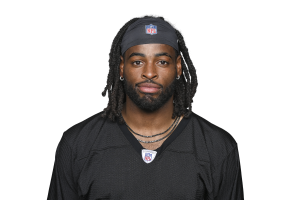
Najee
Harris.
Najee
Harris.
 Alabama
"The most complete three-down back in the class: Alabama volume, Alabama pass-protection reps, and hands you'd expect from a slot receiver. Positional value is the only argument against him."Pre-draft read
He aligns in multiple backfield positions, displaying a wide base and elite contact balance to win between the tackles. His technique features a signature hurdle and spin move, allowing him to leap over defenders or shed tackles. He presents as a complete receiving back, running routes from the slot and out wide, with the body control to execute option, wheel, and angle routes.
He consistently bounces off initial contact, keeps his legs driving through arm tackles, and drags defenders for additional yardage. He shows patience at the line of scrimmage, pressing the play to create cutback lanes and hitting the correct crease in various blocking schemes. He processes blitz looks proactively and delivers a firm punch in pass protection.
Scheme-versatile inside/outside zone runner with a legitimate receiving threat and elite pass protection skills that would excel in a gap/duo power run game.
Immediate starter and bell-cow back on Day 1 with the potential to be a perennial Pro Bowl workhorse.
An Air Raid or spread RPO offense that primarily features quick passes and shies away from power running and full-back sets.
Harris is a three-down workhorse with elite contact balance, vision, and pass-blocking, making him an ideal fit for schemes prioritizing a power run game and a versatile receiving threat.
Best RB in College Football — Alabama RB Najee Harris 2020 Highlights
Najee Harris Career Highlights (2017-2021) — Alabama RB #22
Najee Harris (RB, Alabama) Scouting Report — 2021 NFL Draft
This prospect projects as a three-down power back with a workhorse profile, offering day-one viability in pass protection and as a receiver. His rare contact balance, pass-catching versatility, and advanced pass-blocking technique provide a high floor for immediate impact, justifying a significant investment by teams seeking a complete back. He was widely considered the top running back in his class.
He operated as Alabama's primary ball carrier in 2020, accumulating 251 carries, 1,466 rushing yards, and 26 touchdowns, alongside 43 receptions for 425 yards. This usage demonstrated his capability for a heavy workload. Prior to this, he rotated with other talented backs, indicating a progressive increase in his role within an NFL-style offense.
Concerns centered on his long-speed ceiling, with 40-yard dash times around 4.55 seconds suggesting he might be run down from behind on chunk plays. The valuation of running backs in the first round was also a point of discussion. Despite these considerations, he was drafted 24th overall by Pittsburgh.
- 01
Three-down upside
He projects as a three-down power back with a workhorse profile and day-one viability in pass protection.
- 02
Receiving versatility
He runs routes from the slot and out wide, with body control for option, wheel, and angle routes.
- 03
Elite contact balance
He consistently bounces off initial contact, keeps legs driving, and drags defenders for extra yardage.
- 04
Patient run vision
He shows patience at the line of scrimmage, pressing the play to create cutback lanes.
- 05
Advanced pass-blocking
He processes blitz looks proactively and delivers a firm punch in pass protection.
- 01
Lacks elite long speed
His 40-yard dash times around 4.55 seconds suggest he can be run down from behind.
- 02
Extensive college workload
His Alabama career included a heavy workload of 638 carries and 80 receptions.
- 03
Limited elusiveness
He is more of a physical, one-cut runner than a make-you-miss creator in tight quarters.
- 04
Not explosive-run elite
His production leans on volume and short-area power rather than frequent explosive chunk plays.
Relative Athletic Score (Kent Lee Platte) benchmarks combine/pro-day numbers against every measured prospect at the position since 1987. 10.00 is elite; 5.00 is average.
— No athletic data recorded
| Yr | Team | G | Att | Yds | TD | Rec | RecYds |
|---|---|---|---|---|---|---|---|
| 2017 | Alabama | 14 | 61 | 370 | 3 | 6 | 45 |
| 2018 | Alabama | 15 | 117 | 783 | 4 | 4 | 7 |
| 2019 | Alabama | 13 | 209 | 1224 | 13 | 27 | 304 |
| 2020 | Alabama | 13 | 251 | 1466 | 26 | 43 | 425 |
| Career | — | 55 | 638 | 3843 | 46 | 80 | 781 |
A dash means the figure is not published by a source we trust — never a zero we invented.
Volume runner with size, receiving value and finishing power who can carry a run game even without elite long speed.
Big, patient three-down back with receiving skill and enough creativity to become the center of an offense.
Useful tackle-breaking back whose contact balance travels, but whose explosive limitations cap the overall offensive impact.
Everything above is the pre-draft evaluation. This section is what actually happened — updated year over year.
2021 (rookie, PIT): 307 carries (NFL volume leader), 1,200 yards, 7 TDs, 74 catches — Pro Bowl, All-Rookie. 2022: 272 carries, 1,034 yards, 7 TDs. 2023: 255 carries, 1,035 yards, 8 TDs, 29 catches. 2024: 263 carries, 1,043 yards, 6 TDs — fourth consecutive 1,000+ rushing year, first RB to do it since Le'Veon Bell. PIT did not extend; free agent March 2025. Signed LAC 1-year/$5.25M as Herbert's #1 back. 2025 (LAC): bell-cow role, 800+ yards at midseason. Career_av: 34.
Harris is the cleanest RB evaluation of the 2021 class, and the post-draft career has stubbornly hit the top-15 RB floor despite the market-wide debate over round-1 RB value. His 2020 Alabama season is one of the most complete power-back years of the last decade: 1,466 rushing yards, 26 TDs, 43 catches, 425 receiving yards — Doak Walker, first-team All-SEC, CFP national champion. The signature highlight — the hurdle over the Notre Dame safety in the Rose Bowl — circulated as the visual reference for the class's top-tier contact balance. At 6'1"/232 lbs with 33.5" arms, the biometrics were ideal workhorse. The pro day validated functional athleticism (4.55 forty at 232 lbs) without elite acceleration.
The pre-draft bear case was twofold. One, structural: RB round-1 position value in 2021 was philosophically questionable — David Johnson, Ezekiel Elliott and Todd Gurley had already shown how second contracts collapse. Two, evaluative: YPC at Alabama with a generational OL could be scheme-inflated, and upper-tier but not-elite burst capped the ceiling. Both concerns have been validated almost exactly.
Rookie 2021 with PIT: 307 carries (NFL volume leader), 1,200 yards, 7 TDs, 74 catches — Pro Bowl. Encoded tape: terrible Pittsburgh OL, 3.9 YPC despite the coded contact balance. 2022: 272 carries, 1,034 yards, 7 TDs — second consecutive 1,000+, 68 PFF grade with the OL still deficient. 2023: 255 carries, 1,035 yards, 8 TDs, 29 catches — third consecutive 1,000+ (rare for a modern RB). 2024: 263 carries, 1,043 yards, 6 TDs — fourth straight 1,000+, 71 PFF grade. In March 2025 PIT didn't extend him; he signed with LAC on 1-year/$5.25M as Herbert's #1 back. The production has been consistent but the second contract confirms the market thesis: workhorse production on a rookie deal, market value collapsed on the open market.
The likely Marshawn Lynch comp is close in template (power back with receiving skills), though Harris never had Lynch's explosive plays in Seattle. The Le'Veon Bell ceiling didn't arrive due to insufficient burst and a limiting PIT OL. It's the correct pick for what it was — top-15 RB floor — with the caveat that the floor isn't worth #24 if the second contract collapses.