
Kendrick
Green.
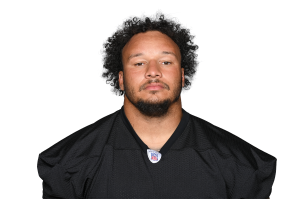
Kendrick
Green.
 Illinois· 6'1"· 305 lb· 4.89s 40
"An Illinois interior lineman converted from defensive tackle who profiled as a center/guard hybrid with plus mobility and a mean streak — a Round-3 developmental bet."Pre-draft read
As a movement-scheme center with a defensive-line background, Green relies on short-area quickness and hand violence. He plays with a wide, athletic base, reaching nose tackles on zone runs with tempo, and climbing to second-level linebackers. His hands are quick and independent, consistently landing the first punch on most snaps. He is most effective in a zone-heavy, quick-game offense that allows him to move rather than absorb impacts.
In pass protection, his feet are quick, but he sometimes plays too tall, which invites the bull-to-jerk and can lead to lunging in recovery. His functional strength on an island can be a trade-off; longer NFL nose tackles can stack him and walk him back on straight bull rushes.
Kendrick Green is a fit for a wide-zone or outside-zone run game that prioritizes athleticism, movement, and second-level blocks from the center position.
Rotational interior lineman in Year 1, with a ceiling of developing into a starting zone-scheme center.
Gap/duo power run game schemes where he's asked to primarily absorb and anchor against larger defensive tackles.
Green's movement skills, quickness, and aggressive play style are ideal for a zone-heavy system where he can get on the move, but his lack of size and issues with anchoring against power make him a poor fit for a man-on-man power scheme.
Illinois Guard Kendrick Green — Official Junior Year Highlights
Cut-up of Green's 2020 tape at Illinois showing reach blocks, second-level climbs, and hand violence at center and guard.
Former Illini Kendrick Green ready for NFL Draft
Pre-draft feature covering his DL-to-OL conversion, Peoria roots, and 2021 draft profile.
Huddle Up and Listen: Kendrick Green
Feature piece on Green's leadership at center for Illinois heading into his final college season.
Kendrick Green projects as a distinctive interior line prospect, a former defensive tackle who transitioned to offensive line at Illinois. He became a full-time starter at both guard and center over three seasons, demonstrating hand quickness and snap-count violence. Green's 4.89-second forty-yard dash at 305 pounds highlighted his movement skills, making him suitable for a zone-heavy scheme.
He primarily operated as a full-time center during his final season, earning second-team All-Big Ten honors. Green's usage showcased his ability to execute reach blocks and climb to the second level. However, the evaluation presented structural risks, including below-standard height and length, and inconsistent anchor reps against more powerful defenders.
Consensus draft boards placed Green in a wide Day 2 range. Teams valuing zone-scheme upside saw him as a strong fit, while others, concerned with length and anchor, viewed him as more of a projection. He was ultimately drafted at pick #87, indicating a willingness to bet on his athletic traits and scheme fit.
- 01
Movement skills
Movement skills — Reaches nose tackles on zone runs with tempo and effectively climbs to second-level linebackers.
- 02
First punch
First punch — Hands are quick and independent, consistently landing the first punch on most snaps in his plays.
- 03
Athletic testing
Athletic testing — Ran a 4.89-second forty-yard dash at 305 pounds, showing zone scheme suitability.
- 04
Positional flexibility
Positional flexibility — Started at both guard and center over three seasons, demonstrating versatility at Illinois.
- 05
Scheme fit
Scheme fit — Most effective in a zone-heavy, quick-game offense that allows him to move not absorb.
- 01
Limited length
Limited length — Below-standard height and length allow longer NFL nose tackles to stack him and walk him back.
- 02
Inconsistent anchor
Inconsistent anchor — Functional strength on an island can be a trade-off; bull rushes can walk him back.
- 03
Pass protection posture
Pass protection posture — Plays too tall in pass protection, inviting the bull-to-jerk and leading to lunging.
- 04
Evaluation concern
Evaluation concern — Structural risks included below-standard height and length, as well as inconsistent anchor.
— — — positional median (p50)
- 40 yd
- 4.89sp50
- Vertical
- 35.5inp50
- Broad jump
- 119inp50
- Three-cone
- 7.79sp50
- Shuttle
- 4.67sp50
- Bench
- 25repp50
| Yr | Team | G |
|---|---|---|
| 2017 | Illinois | 0 |
| 2018 | Illinois | 11 |
| 2019 | Illinois | 12 |
| 2020 | Illinois | 8 |
| Career | — | 33 |
A dash means the figure is not published by a source we trust — never a zero we invented.
Undersized, movement-first interior lineman who profiled as a scheme-dependent starter and settled into a swing/backup role once anchor limits showed up on tape — the fair middle outcome for Green's profile.
Zone-scheme center whose separator is mobility and anchor efficiency rather than mass; a realistic ceiling if Green had cleaned up his pad level and stabilized his pass sets, which he never did.
Athletic but scheme-locked interior lineman whose length and anchor issues capped him as a rotational piece rather than a plus starter; captures the downside Green has trended toward across four teams.
Everything above is the pre-draft evaluation. This section is what actually happened — updated year over year.
Bust. Started Year 1 at center — bottom-5 PFF center grade in the league (allowed 30+ pressures, 4 sacks). Benched Year 2, cut before Year 3. Signed with Houston as depth in 2023, journeyman OL through 2025. Correct developmental grade, wrong slot.
**Pre-draft context.** Kendrick Green arrived at Illinois as a defensive tackle from Peoria (IL) before flipping to the offensive line as a redshirt freshman, then starting at both guard and center across three seasons in Champaign. By 2020 he was Illinois's anchor: a 6'2", 305-pound center with 32⅛-inch arms and a 4.89 forty who tested as one of the twitchiest interior linemen in the class. Second-team All-Big Ten and a Rimington Trophy semifinalist, he entered the pre-draft cycle as a movement/zone-scheme specialist whose defensive line background showed up as violence and hand quickness. Consensus boards had him in a wide day-two range (roughly late-2 to early-4) with a clear split between evaluators who loved the traits and those who flagged the height, length, and reps against SEC-caliber nose tackles.
**NFL fit — Pittsburgh Steelers.** Pittsburgh took Green at #87 and immediately handed him the starting center job over veterans as the heir apparent to Maurkice Pouncey, who had retired that offseason. It was an aggressive fit — a young zone-scheme center behind Ben Roethlisberger's collapsing pocket on an offense that finished dead last in the league in yards per rush. Green started 15 games as a rookie but the tape was uneven: consistent tempo and effort, but real anchor problems against interior power and communication issues on stunts. In 2022 the Steelers moved on from him as a starter, played him at guard on a limited basis, and traded him to Houston in August 2023 for a late-round pick swap — an unusually short leash on a third-round center.
**Retrospective.** Green has since settled into a durable interior reserve role: two seasons in Houston as a swing guard/center (21 games in 2023–24) before joining Cleveland in 2025 and later Buffalo. He is exactly the player the film suggested he might become — a plus mover with fringe-starter anchor, valuable on a roster as a fourth interior lineman who can survive spot starts in a zone scheme. In hindsight #87 was an aggressive slot given the immediate starter expectation; a mid-fourth valuation with a rotational plan probably lines up better with the outcome. The Illinois DL-to-C conversion still shows up as his separator — quick hands, real snap-count violence — but the length and anchor limits capped the ceiling exactly where scouts warned they would.