
Jermar
Jefferson.
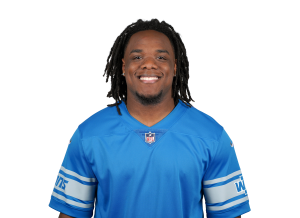
Jermar
Jefferson.
 Oregon St.· 5'10"· 206 lb· 4.57s 40
"A 5'10" Oregon State three-year producer with 4.57 speed but a 2.91 RAS, more vision-and-cutback than juice — a late developmental flier where the college tape outran the athletic profile."Pre-draft read
A compact run-down back who operates best in zone schemes, he wins with vision, plant-foot decisiveness, and contact balance, rather than long speed or open-field elusiveness. He presses the frontside gap, setting up second-level defenders with subtle tempo changes before cutting back off the backside guard’s block with one decisive step. He runs behind his pads with natural forward lean, maintaining a wide base through contact; initial arm tackles slide off as short-yardage runs finish forward.
His hands are dependable on checkdowns and screens, though his route tree is limited to swings, angles, and simple option cuts. He is a natural mover, not a manufactured slot receiver. Pass protection is willing and technically sound in one-on-one situations against linebackers.
A compact, decisive runner best fits outside/inside zone schemes that prioritize vision and contact balance over burst and long speed.
Rotational zone back Year 1, with a ceiling as a reliable committee starter.
Gap/power run scheme, which would negate his vision and force him into less athletic matchups.
A scheme-specific back whose value is tied to finding a system that maximizes his vision and minimizes his athletic limitations.
Jermar Jefferson Oregon State RB Highlights
Game film cut-up of Jermar Jefferson's Oregon St. tape.
Oregon State RB Jermar Jefferson goes for 196 yards and a touchdown | HIGHLIGHTS
Game film cut-up of Jermar Jefferson's Oregon St. tape.
Jermar Jefferson
Game film cut-up of Jermar Jefferson's Oregon St. tape.
He projects as a scheme-specific zone runner with dependable hands out of the backfield and a natural ability to finish runs. Evaluators valued his vision and contact balance, forecasting him as a Day 3 selection capable of contributing depth in a complementary role, particularly within a zone-heavy or duo-based rushing system where his patience and one-cut style are maximized.
He anchored the Oregon State offense as a three-year starter, opening his college career with a 1,380-yard freshman season. He later re-established himself with 858 yards and seven touchdowns on 129 carries in a shortened seven-game slate during the 2020 season. His involvement as a receiver increased throughout his career, demonstrating his utility beyond just rushing.
Pre-draft concerns centered on his athletic profile, notably a 4.57 forty-yard dash and modest explosion metrics that kept his composite RAS under 3. This lack of long speed and functional elusiveness in the open field, combined with questions about his ability to consistently anchor against larger pass rushers, solidified his projection as a sixth- to seventh-round pick, where he ultimately landed as the 257th selection.
- 01
Zone vision
Reads first-level flow and backside color cleanly, pressing the line to force second-level defenders to commit before cutting off blocks with a single decisive step.
- 02
Contact balance
Runs with natural pad level and a wide base through the hole; short-yardage carries routinely finish forward as initial arm tackles slide off.
- 03
Third-down usability
Reliable hands on checkdowns, swings, and simple option routes; showed an ability to uncover on angle and Texas routes without needing manufactured touches.
- 04
Pass protection technique
Willing pickup back who identifies correct assignments in one-on-one situations, meeting rushers at the mesh point with a stab-and-anchor mechanic.
- 05
Ball security
Maintained ball high-and-tight through contact with only two fumbles across 546 college touches, not putting the ball on the ground when plays broke down.
- 01
Long speed
Does not run away from angles once boundary defenders take proper pursuit paths; explosive gains on tape were more structural than true pull-away runs.
- 02
Athletic composite
A 2.91 RAS with a 31-inch vertical and 115-inch broad jump, placing him in the bottom third of drafted backs athletically without a standout burst or explosion trait.
- 03
Elusiveness ceiling
Missed-tackle rate in the open field is patient rather than sudden; he sets up defenders with subtle tempo changes, not lateral quickness or a true jump-cut trait.
- 04
Pass-pro mass
At 206 pounds with 32-inch arms, he can be walked back by blitzing safeties or defensive ends on switch releases; technique is sound but anchor is inconsistent against pure power.
Relative Athletic Score (Kent Lee Platte) benchmarks combine/pro-day numbers against every measured prospect at the position since 1987. 10.00 is elite; 5.00 is average.
— — — positional median (p50)
- 40 yd
- 4.57sp50
- Vertical
- 31inp50
- Broad jump
- 115inp50
- Three-cone
- 7.38sp50
- Shuttle
- 4.38sp50
- Bench
- 13repp50
| Yr | Team | G | Att | Yds | TD | Rec | RecYds |
|---|---|---|---|---|---|---|---|
| 2018 | Oregon State | 12 | 239 | 1381 | 12 | 25 | 147 |
| 2019 | Oregon State | 9 | 142 | 685 | 8 | 9 | 85 |
| 2020 | Oregon State | 6 | 133 | 858 | 7 | 9 | 67 |
| Career | — | 27 | 514 | 2924 | 27 | 43 | 299 |
A dash means the figure is not published by a source we trust — never a zero we invented.
Undersized rotational back whose NFL value came from receiving usage and pass-pro reliability rather than volume between the tackles.
Compact zone back who carved out a real backup role behind a starter with reliable third-down hands and short-yardage finish — realistic if the vision translated cleanly.
Late-Day 3 zone back who bounced on and off practice squads without stacking meaningful active-roster snaps.
Everything above is the pre-draft evaluation. This section is what actually happened — updated year over year.
Pre-draft context. A three-year Oregon State starter measured at 5'10", 206 pounds with 32-inch arms, Jefferson opened his career with a 1,380-yard true-freshman season in 2018 and closed it with a compressed but efficient 2020 campaign — 858 yards and seven touchdowns on 129 carries in seven games. The 2021 combine cancellation forced evaluators onto his Corvallis pro day, where a 4.57 forty, 31-inch vertical and 115-inch broad jump produced a 2.91 composite RAS. Board consensus settled in the sixth-to-seventh-round tier: evaluators trusted the vision, the balance and the receiving toolkit but flagged the lack of long speed and explosion.
NFL fit — Detroit Lions. Detroit spent the 257th selection on Jefferson late on Day 3 as a developmental complement behind D'Andre Swift and Jamaal Williams. He made the Week 1 active roster as a rookie and finished 2021 with limited work — a handful of carries and a lone rushing touchdown in Week 18 against the Packers when the depth chart thinned. He spent 2022 primarily on Detroit's practice squad and cycled through the Chicago Bears' practice-squad structure in 2023, without breaking through to consistent regular-season touches.
Retrospective. Jefferson's NFL arc played out the way the pre-draft athletic profile hinted it might: the vision, hands and balance were legitimate, but the lack of separator speed and elusiveness left him competing for RB4 reps in a league that increasingly asks its bottom-of-roster backs to hit either as core special-teamers or as third-down passing-game weapons. He remained a name teams brought back on futures deals rather than a rotational contributor, which is the honest ceiling of a 2.91-RAS Round-7 back whose best college trait was patience rather than juice.