
Jack
Anderson.
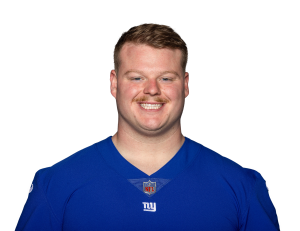
Jack
Anderson.
 Texas Tech· 6'4"· 314 lb· 5.28s 40
"A 6-foot-4, 314-lb Texas Tech guard with 41 career starts, a 27-rep bench, and an 8.01 RAS built on power splits — a late-round developmental interior blocker whose short-set anchor was the argument, not the feet."Pre-draft read
Interior offensive lineman projects cleanest at right guard with emergency center flex. He wins with initial punch and stacked-hand pop through contact, exhibiting heavy hands that recoil defenders on down blocks and short-yardage combos. His naturally wide base and weight distribution on drive blocks make first-level movement in gap and duo concepts his cleanest rep type.
Pass protection is a two-step story: in his short set, he anchors squarely and re-fits hands to handle bull rushers. In his vertical set, his feet get tight, his punch times late, and speed-to-power rushers get under his chest plate. Recovery is a limitation; once the initial angle is lost, his hip flip and lateral shuffle to wall off the pocket are heavy. He is a straight-line puller who struggles to adjust in space.
Gap/duo power run game
Rotational power guard as a rookie, with a high-end ceiling as a long-term starter at right guard in a run-heavy scheme.
A pass-heavy spread RPO system that asks guards to frequently vertical set or adjust to moving targets in space.
Anderson's power and anchor traits make him a natural fit for a physical, downhill run scheme, while his limited lateral quickness and pass-set foot speed would be exposed in more athletic, pass-oriented attacks.
Jack Anderson - Ultimate Highlights
Game film cut-up of Jack Anderson's Texas Tech tape.
Jack Anderson (Highlights)
Game film cut-up of Jack Anderson's Texas Tech tape.
Jack Anderson '22 pre-szn HL
Game film cut-up of Jack Anderson's Texas Tech tape.
Anderson profiles as a developmental guard with legitimate power traits, best suited for a redshirt-first project. His frame, length through the torso, and anchor against Big 12 nose tackles are translatable. He projects as a player whose best usage will come in gap and duo schemes where his down-block torque is maximized, rather than vertical-set pass protections.
He entered the process as a four-year starter, logging 41 career starts across right guard and center in a spread offense that utilized shotgun and RPO. His collegiate experience provided a foundation in multiple line calls and protections, though it did not always demand a polished vertical pass set. A shoulder history limited his 2019 tape, impacting the sample size of clean junior reps evaluators used.
Board consensus placed him firmly on Day 3 due to concerns about his pass-set foot speed, play strength on the move, and scheme adjustment for NFL-huddle protections. Despite these flags, his power indicators and positional versatility made him a viable late-round selection. He was drafted by Buffalo at pick 236.
- 01
Anchoring power
Absorbs initial jolt and refits hands to maintain pocket integrity against bull rushes.
- 02
Powerful down blocker
Sinks hips and drives interior defenders off the ball in gap and duo schemes.
- 03
Size and build
Six-foot-four, 314 pounds with compact, thick build; torso length withstands interior defenders.
- 04
Hand lockout
Once hands land inside the framework, lockout is genuinely difficult to shed in phone-booth pockets.
- 05
College experience
Four-year starter at right guard and center, learning multiple line calls in a Power Five conference.
- 01
Pass set feet
Vertical-set kick-slide is heavy, and second step lands late, opening inside lanes.
- 02
Recovery limitation
Once leverage is lost, hip flip is deliberate, rarely walling off the pocket effectively.
- 03
Range in space
Straight-line puller struggles to adjust to moving targets at the second level.
- 04
Scheme transition
Adapting from college spread scheme to NFL-huddle calls is a legitimate multi-year project.
Relative Athletic Score (Kent Lee Platte) benchmarks combine/pro-day numbers against every measured prospect at the position since 1987. 10.00 is elite; 5.00 is average.
— — — positional median (p50)
- 40 yd
- 5.28sp50
- Vertical
- 29.5inp50
- Broad jump
- 105inp50
- Three-cone
- 7.90sp50
- Shuttle
- 4.83sp50
- Bench
- 27repp50
| Yr | Team | G |
|---|---|---|
| 2017 | Texas Tech | 13 |
| 2018 | Texas Tech | 12 |
| 2019 | Texas Tech | 3 |
| 2020 | Texas Tech | 10 |
| Career | — | 38 |
A dash means the figure is not published by a source we trust — never a zero we invented.
Career interior swing body who earns a roster spot on positional flexibility at guard and center, plays winning football when protected by scheme and pocket geometry, and cycles between spot starts and dependable backup snaps across multiple contracts.
Optimistic outcome where a redshirt year, a scheme fit built around gap/duo runs, and a coaching investment in punch timing unlock the same power-guard profile — plus starter at right guard who wins with anchor and finish, not lateral range.
Downside outcome where pass-set foot speed never catches up to NFL interior rush and shoulder maintenance costs a full offseason of development — a practice-squad-caliber career that never converts the frame into stable game-day snaps.
Everything above is the pre-draft evaluation. This section is what actually happened — updated year over year.
Pre-draft context. Jack Anderson arrived at the 2021 draft as a 6-foot-4, 314-pound four-year Texas Tech starter with 41 career starts, a 27-rep bench, and an 8.01 RAS profile weighted toward power indicators over lateral quickness. Board consensus placed him on Day 3 as a developmental interior blocker: the frame, the anchor against Big 12 nose tackles, and the down-block finish traveled, but the pass-set foot speed and a shoulder history that limited 2019 tape kept him out of the priority Round-6 tier.
NFL fit — Buffalo Bills. Buffalo took Anderson at 236 as a redshirt-first project behind a settled interior. He was waived at final cuts, claimed off waivers by the Philadelphia Eagles, and spent his rookie year as a depth interior body cycling between active rosters and practice squads. He later moved to the New York Giants system, earning spot starts at right guard across the 2022–2023 seasons when injuries opened the lineup, then continued as a swing interior piece cycling between practice squad and 53-man roster on veteran-minimum deals.
Retrospective. As a Round-7 flier, Anderson has cleared the low bar of the slot: he has been an NFL body across multiple organizations, appeared in regular-season games, and delivered spot starts when called. The ceiling implied by the anchor and the four-year starter volume never fully materialized — the pass-set feet and recovery limitations forecast in the pre-draft grade have been the ceiling in the pros — but the profile has held up as a fringe swing interior lineman, which is exactly the outcome band a late-Round-7 interior guard is drafted to hit.