
Frank
Darby.
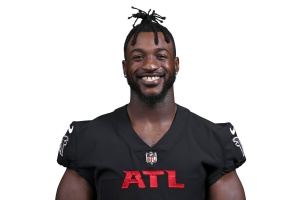
Frank
Darby.
 Arizona St.· 6'0"· 201 lb· 4.56s 40
"A 6'0", 201-pound Arizona State vertical specialist with a 34.5" vertical and 8 TDs in 2019 but only 4 games in 2020 — a Round-6 field-stretcher bet on speed and body control over polish."Pre-draft read
Darby's game is built on releases, stack-and-take-the-top verticals, and body control at the catch point. Off the line he shows enough foot quickness and hand fighting to defeat single-high press when the defender opens his hips. Once stacked, he tracks deep balls smoothly with his head around, adjusting to under- and overthrown vertical routes. In contested-catch spots he is willing and effective, plucking outside the frame and high-pointing on posts and back-shoulder throws.
The limits of his game appear in the middle of the route tree: intermediate breaks are rounded, and he leans on speed instead of stem manipulation to create separation on slants and digs. He is not a plus YAC threat after short catches because he runs a little tall out of gathers.
Shanahan outside zone passing game, which prizes vertical threats to open up the middle of the field and run after catch opportunities underneath.
Year 1 as a WR3/4 vertical specialist and core special teams gunner, with a ceiling of developing into a starting X-receiver in a run-heavy vertical offense.
Any West Coast timing-based scheme requiring a nuance for intermediate routes and YAC from its receivers.
Darby fits best as a designated vertical threat in a play-action heavy offense, relying on his downfield tracking and contested-catch ability with legitimate special teams value.
Frank Darby 2019 Highlights
Junior-year Arizona State reel showing the deep-ball tracking and 19.9-yard average that anchored the draft grade.
2021 NFL Draft Profile: Arizona State WR Frank Darby
Conference-produced pre-draft profile with pro-day numbers and Senior Bowl context.
Frank Darby 40-yard TD catch vs. Colorado
Single-play example of the release, stack and over-the-shoulder catch that defined his college role.
Darby projects as a vertical-first outside receiver whose game relies on downfield ability and contested catches. His production during his junior season, with 19.9 yards per reception and 8 touchdowns, supported the idea of an X-slash-flanker vertical specialist.
His role at Arizona State primarily leveraged his deep-threat capabilities, often working opposite another prominent receiver. The 2019 season showcased his ability to stretch the field, but a limited 2020 campaign in a COVID-shortened season reduced his total collegiate sample size. His route tree was tilted toward verticals, suggesting a specialized usage.
Evaluators noted concerns about volume and route diversity, which pointed to a more defined role rather than a versatile one. Despite these flags, his performance at the Senior Bowl and pro day testing provided a baseline for his athletic projection. He was selected 187th overall by Atlanta, reinforcing his Day 3 market value as a potential WR5 who could contribute on special teams due to his effort as a gunner.
- 01
Downfield tracking
locates and adjusts to the deep ball with head around, particularly on back-shoulder and over-the-shoulder throws, which drove his 19.9 yards-per-catch average as a junior.
- 02
Athletic profile
4.56 forty, 34.5" vertical, 117" broad and 7.05 three-cone produced a 7.55 RAS at 201 pounds and validated the vertical archetype scouts saw on tape.
- 03
Release package
enough hand fighting and foot quickness off the line to defeat single-high press, which is the release layer required for an NFL vertical role opposite a true X.
- 04
Contested-catch temperament
willing hands attacker on 50/50 balls, high-points posts and back-shoulders and did not shrink from physicality at the catch point despite a leaner frame.
- 05
Senior Bowl and gunner effort
Mobile week showed the compete level, and he projected as a legitimate core-four special-teams gunner, which is the classic Day 3 stick tool.
- 01
Thin 2020 sample
only 12 catches in the Pac-12's four-game COVID season removed the follow-up film evaluators wanted after a touchdown-heavy 2019 breakout year.
- 02
Rounded intermediate routes
leaned on top-end speed rather than stem manipulation and did not consistently create separation on digs, slants and 15-yard curls.
- 03
Modest volume résumé
a 31-catch peak season with just 74 career receptions capped the confidence in the profile and pushed evaluators toward vertical-only projections.
- 04
Average YAC after short catches
ran a little tall out of gathers and did not stack broken tackles, which limited his slot and screen-game upside at the next level.
Relative Athletic Score (Kent Lee Platte) benchmarks combine/pro-day numbers against every measured prospect at the position since 1987. 10.00 is elite; 5.00 is average.
— — — positional median (p50)
- 40 yd
- 4.56sp50
- Vertical
- 34.5inp50
- Broad jump
- 117inp50
- Three-cone
- 7.05sp50
- Shuttle
- 4.25sp50
- Bench
- 19repp50
| Yr | Team | G | Rec | Yds | TD |
|---|---|---|---|---|---|
| 2017 | Arizona State | 13 | 9 | 234 | 2 |
| 2018 | Arizona State | 13 | 21 | 421 | 2 |
| 2019 | Arizona State | 12 | 31 | 616 | 8 |
| 2020 | Arizona State | 2 | 6 | 46 | 1 |
| Career | — | 40 | 67 | 1317 | 13 |
A dash means the figure is not published by a source we trust — never a zero we invented.
Late-round vertical body who cycled through WR5 depth chart spots without a defined route tree — a fair descriptor of Darby's Atlanta run.
Long-strider vertical specialist whose deep-only route tree produced a real WR3 role opposite a star target — the upside outcome for Darby.
Speed-first Day 3 receiver whose NFL role never expanded past preseason flashes before he found a second act elsewhere.
Everything above is the pre-draft evaluation. This section is what actually happened — updated year over year.
Pre-draft context. Darby arrived at Arizona State from Lincoln High in Jersey City as a track-fast, big-play receiver and built his draft case on a 2019 season that was almost entirely home runs: 31 receptions for 616 yards (a 19.9-yard average) and 8 touchdowns as Arizona State's primary vertical threat opposite Brandon Aiyuk. The Pac-12's truncated 2020 slate (four games, 12 catches, 219 yards, 2 TDs) removed most of the follow-up film. He was one of the Senior Bowl's more spirited players in Mobile and tested cleanly at ASU's pro day: 6'0"/201, 4.56 forty, 34.5" vertical, 117" broad jump, 7.05 three-cone, 4.25 shuttle and 19 bench reps for a 7.55 RAS — a solid but not elite athletic profile that supported the vertical projection more than the polish.
NFL fit — Atlanta Falcons. Atlanta grabbed Darby at #187 with the idea of adding a downfield element behind Julio Jones and Calvin Ridley in their new offense, and by all accounts he made the roster on flashes in camp. A calf injury early in the 2021 season stalled his rookie year, and across 2021-22 he cycled between the active roster and inactive lists, finishing his Falcons tenure with 5 career receptions for 63 yards before being released in August 2023. He signed briefly with the Chiefs practice squad, then bet on himself in the UFL, where he became one of the St. Louis Battlehawks' top receivers in 2024 and 2025 — the exact vertical role his ASU tape suggested he could hold.
Retrospective. As a Day 3 shot at speed, the Falcons got a preseason contributor who never turned camp flashes into a Sunday role, which is a fair definition of a Round-6 miss even at a low investment cost. The pre-draft flags (thin route tree, one-year peak, condensed 2020 sample) were exactly what limited him in Atlanta, and the second-act UFL production suggests the archetype was real; it just did not translate at the NFL layer of coverage and detail.