
Cornell
Powell.
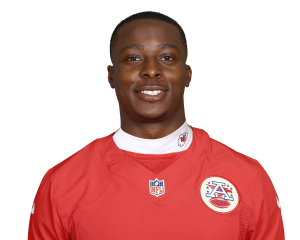
Cornell
Powell.
 Clemson· 6'0"· 204 lb· 4.53s 40
"A 6'0", 204-pound five-year Clemson senior who caught 15 passes in four years before a 53/882/7 breakout in 2020, backed by a 9.11 RAS — a Round-5 developmental Z where the one-year sample was the whole case."Pre-draft read
He aligns in-line and from the slot, working the intermediate levels of the field, where he leverages his length and body control at the catch point. His primary strength is contested tracking downfield; he stems with patience, uses a subtle late hand to shield defenders, and adjusts to underthrown fades and back-shoulders using above-average ball skills. His hands are reliable within his frame, and he catches the ball away from his pads.
His release package is limited; he is a build-up strider and not a snap-quick separator. His transitions out of vertical stems are rounded, which requires the quarterback to throw him open on speed-outs and comebacks. As a run blocker, he offers adequate effort and length on the edge but does not consistently finish blocks.
This player is best suited for an Air Raid or spread RPO system that prioritizes length and contested-catch ability on intermediate routes, rather than snap-quick separation.
Year 1 depth Z receiver with special teams contributions, with a ceiling as a starting Z for a pass-heavy offense who can win on back-shoulder fades and vertical seams.
A West Coast timing-based offense that demands precise route breaks and immediate separation from its receivers will not maximize his skill set.
Powell's limited separation quickness and older rookie age make him a niche fit, best utilized in schemes that can exploit his deep ball tracking and contested-catch ability.
Cornell Powell NFL Draft Tape | Clemson WR
Full 2020 senior-season cutup showing the vertical wins and ACC Championship tape that drove the Round-5 grade.
Hidden Gem — Cornell Powell 2020 Season Highlights
Extended highlight reel of the breakout senior year including the Notre Dame two-touchdown game.
Clemson WR Cornell Powell 28-Yard TD vs Ohio State
College Football Playoff semifinal vertical touchdown against Ohio State, one of his cleanest boundary reps on tape.
He projects as a developmental Z with the physical frame to operate in an X-receiver role, offering a team a player best suited to work the intermediate levels of the field. His length, body control, and ball-tracking skills allow him to win at the catch point, particularly on contested vertical passes, and his athletic profile (9.11 RAS) supported a late-round projection for teams willing to develop his route-running.
His senior season at Clemson produced 53 receptions for 882 yards and 7 touchdowns, culminating in a 139-yard, two-score performance against Notre Dame in the ACC Championship. This marked a significant uptick from his previous four years, during which he logged just 15 career receptions. He played off in-line X, motion Z, and detached slot alignments, running a full ACC-caliber route tree.
Scouts were divided on his single year of significant production and his rookie age of 24, which limited his developmental runway. Concerns about his separation quickness and release package against press coverage were noted. Consensus projected him as a Rounds 5-6 developmental Z, aligning with his selection at pick 181 by Kansas City.
- 01
Ball tracking and contested-catch feel
Tracks the deep ball with above-average timing, adjusts to underthrows and back-shoulders, and uses length to shield at the catch point on fades and vertical seams down the boundary.
- 02
Athletic testing profile
9.11 RAS on a 6'0", 204 frame with a 4.53 forty, 36.5" vertical and 128" broad jump gave evaluators a clean movement baseline that matched the late-season tape on vertical stems.
- 03
Senior Bowl week
Won reps in Mobile against Round 2-4 corners, showed clean releases against press in one-on-ones and stacked defenders on go routes, which forced re-grades on tape that had been graded as a rotational-only ceiling.
- 04
ACC title-game tape
8 catches for 139 yards and 2 touchdowns against a Notre Dame secondary featuring multiple future NFL corners, including a full-field post that was the highest-graded rep of his college career.
- 05
Frame and length for the Z role
Long arms and a filled-out 204-pound build let him work through contact on intermediate crossers and slants, giving offenses a body-catcher on third-and-medium off-slot alignments.
- 01
One-year production sample
15 career catches through four years before the 2020 breakout, and evaluators had no way to separate scheme (Trevor Lawrence, Clemson spacing) from a real trait upgrade in the senior tape.
- 02
Rookie age
Turned 24 during his rookie season after a redshirt and a fifth year, meaning any developmental runway had to translate immediately without the usual 22-year-old growth curve behind it.
- 03
Separation quickness
Builds to top speed rather than winning early, and stem-to-break transitions are rounded, which showed up against ACC corners in coverage and again in Kansas City preseason work.
- 04
Release package versus press
Beat off-coverage cleanly at Clemson but showed limited hand usage and counter moves when jammed at the line, which projected as a real problem against NFL boundary corners.
Relative Athletic Score (Kent Lee Platte) benchmarks combine/pro-day numbers against every measured prospect at the position since 1987. 10.00 is elite; 5.00 is average.
— — — positional median (p50)
- 40 yd
- 4.53sp50
- Vertical
- 36.5inp50
- Broad jump
- 128inp50
- Three-cone
- 7.03sp50
- Shuttle
- 4.21sp50
- Bench
- 16repp50
| Yr | Team | G | Rec | Yds | TD |
|---|---|---|---|---|---|
| 2016 | Clemson | 11 | 12 | 87 | 0 |
| 2017 | Clemson | 8 | 8 | 57 | 1 |
| 2018 | Clemson | 3 | 5 | 63 | 0 |
| 2019 | Clemson | 9 | 15 | 122 | 2 |
| 2020 | Clemson | 12 | 53 | 882 | 7 |
| Career | — | 43 | 93 | 1211 | 10 |
A dash means the figure is not published by a source we trust — never a zero we invented.
Long-strider vertical Z who wins with tracking and straight-line speed but never becomes a full-time separator — the realistic ceiling a Round-5 senior breakout was chasing.
Best-case big-Z outcome where the frame, tracking, and contested-catch skill translate into a 900-yard boundary starter opposite a true X.
Clemson receiver with size and testing who never converted college role-player traits into an NFL rotation — the outcome Powell ultimately followed onto the practice-squad carousel.
Everything above is the pre-draft evaluation. This section is what actually happened — updated year over year.
Pre-draft context. Powell arrived at Clemson as a 2016 top-100 recruit and spent four years buried behind an NFL pipeline of receivers (Mike Williams, Deon Cain, Tee Higgins, Justyn Ross, Amari Rodgers), catching just 15 passes through 2019. As a fifth-year senior in 2020 he finally moved into a full-time role and posted 53 catches for 882 yards and 7 touchdowns, capped by a 139-yard, two-score ACC Championship performance against Notre Dame. He measured 6'0", 204 at the Senior Bowl and Clemson pro day, then tested at a 9.11 RAS with a 4.53 forty, 36.5" vertical and 128" broad, giving evaluators a clean athletic profile to marry to the late tape. Consensus board slotted him Rounds 5-7 given the age (turned 24 as a rookie) and the one-year production sample.
NFL fit — Kansas City. The organization used pick 181 on Powell as a developmental Z behind Tyreek Hill, Mecole Hardman, and Demarcus Robinson, betting that a full offseason inside the team's route tree would translate the senior tape. The bet did not cash. Powell was waived at final cuts in August 2021, briefly stashed on the practice squad, and never carved out a rotational role in Kansas City's three-receiver packages. He signed a futures deal for 2022, was released again in camp, and cycled through the Panthers and Bears practice squads without a regular-season target of note.
Retrospective. Powell's NFL ledger sits at zero regular-season receptions across three years on the fringe of active rosters. He resurfaced in 2024 with the DC Defenders of the UFL, where the traits — length, tracking, straight-line juice — showed up in a smaller pond. The pick reads as a classic late-round senior-breakout trap: a testing profile and one dominant season were not enough to overcome four dormant years of development and a rookie age that gave no runway to grow into a role behind entrenched starters.