
Anthony
Schwartz.
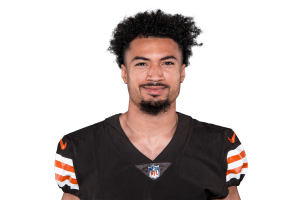
Anthony
Schwartz.
 Auburn· 6'0"· 186 lb· 4.27s 40
"An Auburn WR with 4.26 speed, an SEC track background and a drop problem — the fastest player in the class and a Round 3-4 gadget projection."Pre-draft read
He aligns as a Z receiver or in orbit motion, working to get clean releases on vertical routes. He wins with raw acceleration, utilizing his top-end speed on go routes and post routes, often off play-action. His best work comes on pre-designed touches like jet sweeps, tunnel screens, and orbit motion, where his speed is leveraged in open space with minimal route complexity.
His release package against press coverage is underdeveloped; he struggles with a narrow frame and average play strength, often getting rerouted at the line. His intermediate route tree lacks deception and pace changes common in NFL possession receivers. He displays inconsistent hands, with concentration drops and body-catching tendencies, and his run-after-catch ability is linear, relying solely on speed.
Any play-action heavy, run-first scheme that prioritizes vertical field-stretchers and manufactured touches over nuanced route-running and contested catches.
Immediate Year 1 role as a designated deep threat, gadget player, and kick returner with the ceiling to be a rotational Z-receiver if hands and route detail improve.
The value of a speed-only receiver with underdeveloped hands and route detail collapses in a pass-heavy, pro-style offense that asks its WRs to win consistently on timing routes and contested catches.
Schwartz is a singular, elite speed element whose fit is maximized in an offense that can scheme him into space and create easy opportunities for his outlier trait.
The Fastest Player in College Football — Anthony Schwartz 2019 Auburn Highlights
Full 2019 Auburn cutup: jet sweeps, tunnel screens and vertical routes that anchored his mid-round speed grade.
Anthony Schwartz, WR, Auburn
Pre-draft profile reel with the manufactured touches and deep-ball reps NFL front offices actually evaluated at #91.
Anthony Schwartz — 60 meter semifinal, 6.62
Track evidence for the outlier long speed the entire evaluation was built on — SEC 60-meter semifinal against national-caliber sprinters.
Anthony Schwartz projects as a vertical Z or gadget field-stretcher, a role entirely predicated on his elite, differentiating long speed. Teams would acquire him to create explosive plays through manufactured touches and to stretch the field, forcing defensive adjustments with his top-end acceleration. His 4.26-second forty time is a key differentiator, influencing defensive coverage schemes.
His three-year college career at Auburn featured 79 receptions for 1,433 yards and six touchdowns, often relying on manufactured touches rather than a diverse route tree. He was deployed frequently on jet sweeps, screens, and orbit motion, showcasing his ability to convert speed into production in scripted situations, which was a significant part of his college usage and production.
Evaluators consistently flagged concerns regarding his inconsistent hands, slight frame against press coverage, and limited route-running beyond vertical routes. The consensus placed him in the late third to early fourth-round range, viewing him as a developmental deep threat with a gadget ceiling. The Browns' selection at pick #91 reflected a strategic fit for their play-action scheme, despite the clear risk associated with a one-trait projection against multiple material weaknesses.
- 01
elite speed
Exhibits 4.26-second forty yard dash time, a game-changing differentiating trait for a perimeter player.
- 02
manufactured touches
Excels on jet sweeps, tunnel screens, and orbit motion, leveraging speed in open space.
- 03
quick acceleration
Reaches top speed quickly, gaining separation on go routes and post routes effectively.
- 04
gadget role player
Offers immediate utility in special teams and gadget roles with motion concepts.
- 05
track background
Demonstrates discipline and training habits from 100-meter track career, indicating work ethic.
- 01
inconsistent hands
Displays concentration drops and body-catching tendencies, hindering reliable receptions.
- 02
route tree limited
Lacks deception and pace changes for intermediate routes, relying only on vertical speed.
- 03
undersized frame
Struggles vs. press coverage due to narrow frame and average strength, often rerouted.
- 04
limited production
Recorded 79 receptions for 1,433 yards and 6 touchdowns over three college seasons.
— — — positional median (p50)
- 40 yd
- 4.27sp50
- Vertical
- 32inp50
- Broad jump
- 123inp50
- Three-cone
- 7.13sp50
- Shuttle
- 4.25sp50
- Bench
- —rep
| Yr | Team | G | Rec | Yds | TD |
|---|---|---|---|---|---|
| 2018 | Auburn | 13 | 23 | 392 | 2 |
| 2019 | Auburn | 13 | 41 | 440 | 1 |
| 2020 | Auburn | 10 | 54 | 652 | 3 |
| Career | — | 36 | 118 | 1484 | 6 |
A dash means the figure is not published by a source we trust — never a zero we invented.
Slightly built speed receiver with real deep-ball value on 15–20 snaps a game and a short 4–5-year career defined by scheme-fit deployment rather than volume production — a very close comp for how Schwartz was actually used in Cleveland.
Track sprinter-turned-Z receiver whose entire NFL value was straight-line speed and manufactured deep shots; Goodwin's stretches as a 4th WR / vertical package specialist (Bills, 49ers, Bears) represent the realistic upside outcome if Schwartz had cleaned up drops.
Elite-testing sprinter (record-setting 4.22 forty) whose NFL production never approached the pre-draft hype because hands, health and route detail did not scale; the outcome Schwartz's evaluation warned about, and the outcome that ultimately hit.
Everything above is the pre-draft evaluation. This section is what actually happened — updated year over year.
Bust. 10 catches for 135 yards across two seasons in Cleveland, cut in 2023. Signed with Chicago and Houston on futures deals, out of the league by 2024. Speed always played; the hands and separation never did.
**Pre-draft context.** Anthony Schwartz arrived at the 2021 NFL Draft as one of the most extreme speed profiles in modern draft history. A 6'0", 186-pound Auburn wideout with track credentials most football prospects can only imagine — a personal-best 10.07 in the 100 meters, a 6.49 60-meter dash, three years as a top-tier SEC sprinter — Schwartz ran a 4.26 unofficial 40 at his Auburn pro day and had run a documented 4.28 laser in high school. On the field, he was a three-year contributor at Auburn as part of a run-heavy attack, but the production never matched the tools: 79 catches for 1,433 yards and six touchdowns across three seasons, with jet sweeps, screens and manufactured touches accounting for a large share of his usage. Boards had him firmly in the third- to fourth-round range as a developmental deep threat and gadget piece; every major evaluation flagged inconsistent hands, a slight frame and route-tree limitations, while acknowledging the speed alone justified a mid-round bet.
**NFL fit — Cleveland Browns.** The Cleveland organization took Schwartz at #91 to give Baker Mayfield a designed vertical accelerator opposite Odell Beckham Jr. and Jarvis Landry — a role that had been filled in prior wide-zone play-action offenses and a natural fit for Cleveland's system. The plan was narrow but sensible: 10–15 snaps a game as a field-stretcher, manufactured touches on jet motion, and situational deep shots to punish soft coverage. The execution never landed. Drops surfaced in camp and never went away, a foot injury cost him time as a rookie, and the change from Mayfield to Deshaun Watson in 2022 did not unlock the deep shots the scheme had projected. Schwartz finished his three Cleveland seasons with 15 catches for 165 yards and one score before being waived in August 2023.
**Retrospective.** Schwartz's post-Cleveland résumé — practice-squad stints with the Bears, Bengals and 49ers, no meaningful offensive production — has hardened the pick into one of the clear misses of the 2021 third round. The retrospective indicts the evaluation, not the athlete: NFL scouting departments had a decade of data on 4.2-range receivers whose hands and route detail did not scale, and the Browns leaned on the outlier speed anyway. Against the ceiling outcomes of the round (Creed Humphrey at 63, Elijah Moore at 34, Amon-Ra St. Brown at 112) the pick reads as a talent-evaluation error rather than a developmental one — Schwartz is exactly the player the pre-draft reports described.